Director-led delivery: what changes when the director walks every site
On a remedial job the director who wrote the scope and the person on site are the same. Here is what that changes when the slab opens up and the unknowns surface.
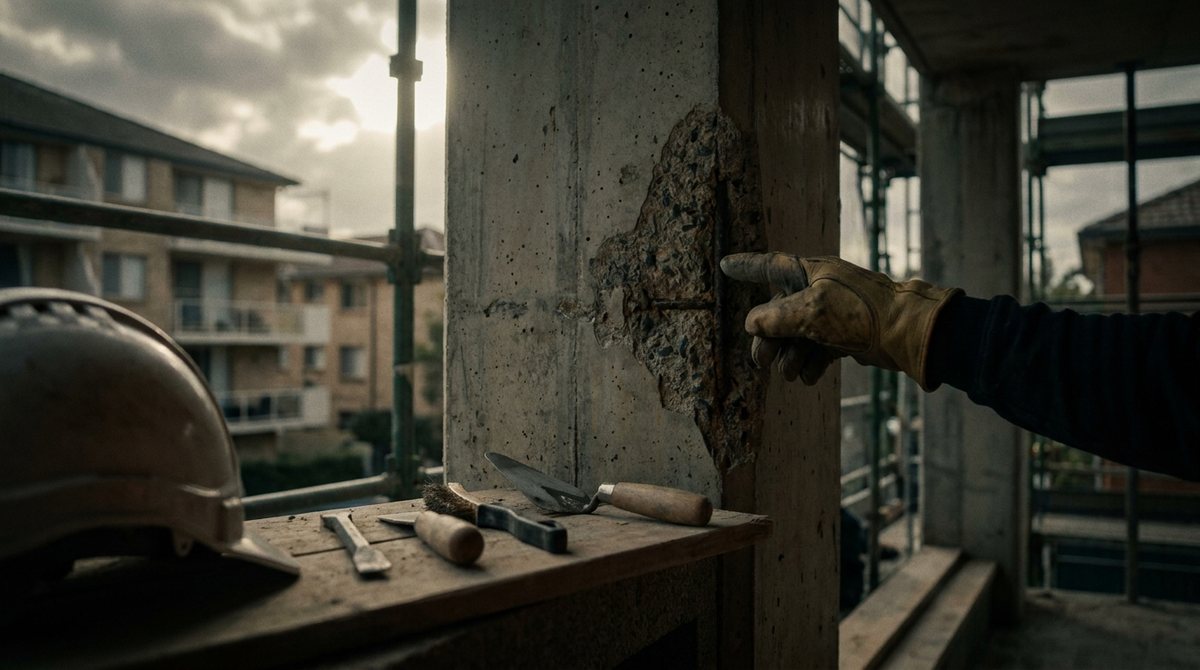
A 2007 Chatswood podium opens up during a planter rectification and the membrane area is larger than the survey caught. On a large firm that moment travels up a chain. The trade team flags it to a site supervisor, who flags it to a project manager, who emails the strata manager a variation written by someone who never saw the slab. On a director-led job the person standing over the open slab is the person who wrote the scope. The call gets made on the spot, in writing, with the strata manager looped in the same day.
That difference, who is on site when the unknown surfaces, is what director-led delivery actually means.
Remedial work surfaces unknowns by nature
Every remedial scope is written on the best available evidence before break-out. A cover meter survey, moisture readings, a hammer-tap sounding, a visual inspection. Good evidence narrows the unknowns. It does not remove them. The true extent of a spall, the real condition of a membrane upstand, the actual falls under a tiled deck, none of these are fully confirmed until the deck is open.
So on most major jobs something is found that the scope could not have fully predicted. The slab edge is more spalled than the sounding suggested. The drain has been running at half capacity for years and the falls correction needs more screed to meet AS 4654.2. The membrane has failed at a junction the survey could not reach. This is not a scope failure. It is the nature of opening up a building that has been deteriorating behind a finish for a decade.
Who handles the unknown decides the outcome
When the unknown surfaces, someone decides what happens next. On a layered firm that decision passes through people who were not there. Information degrades at each handoff. The strata manager receives a variation they cannot easily tell apart from a scope gap, because the person who wrote it cannot explain the slab they never stood over.
When the director is on site, the decision is made by the person who holds the whole scope in their head. They know why the original boundary was drawn where it was. They can see immediately whether the new finding sits inside the intent of the scope or genuinely extends it. The variation, if there is one, is explained in plain terms to the strata manager that day, with a photo of the actual condition, not a line item written from a desk.
What the strata manager gets from it
Fewer surprises that cannot be explained. A variation that arrives with the reason attached, not a one-line email the manager cannot translate for the committee. A single point of accountability who was physically present for the decision. The work proceeds because the manager can defend it, and the manager can defend it because the person who made the call can account for it.
This is the quiet advantage of a firm where the director is one of the trade team rather than three management layers above it. The thirty years of construction heritage in the family reaches the site directly, in the room when the call gets made, not relayed through a chain that thins it out.
Where the director should be on the programme
Director-led does not mean the director lays every trowel. It means the director is present at the points where judgement decides the outcome. At scope, walking the building and writing what the evidence shows. At the major milestones, when the deck is open and the real condition is visible. At handover, when the punch list gets walked and closed. Between those points the trade team runs the work to the scope, and the director is reachable when a call needs making.
What to do next
- Ask whether the director walks the site during construction or only at scope and handover. The answer changes how surprises get handled.
- Ask who makes the call when the slab opens up and the extent is larger than scoped. Look for a named person who is physically on site, not a chain.
- Ask for variations to arrive with a photo of the actual condition and a plain explanation, not a single line item.
- Treat a single accountable point of contact who was present for the decision as worth real margin on a major scope.
How Supcon handles this
Thomas Pencarinha walks every site at scope, at the major milestones, and at handover. When a deck opens up and the extent is larger than the survey caught, the call gets made on site, in writing, with the strata manager in the loop that day. There is no translation layer between the person who wrote the scope and the person doing the work.
The variation rate stays low because the original scope is tight and the surprises get handled by the person who understands the whole job. See why three decades behind a remedial director matters for the family backbone, and one family standard from diagnosis to handover for how that standard holds across the programme.
Get a remedial scope. Send through the issue.