Expansion joint failures in mid-rise Sydney buildings
An expansion joint lets a building move without cracking. When the joint seal fails, water gets in and the cracking starts anyway. Here's why mid-rise Sydney expansion joints fail and how they are rectified.
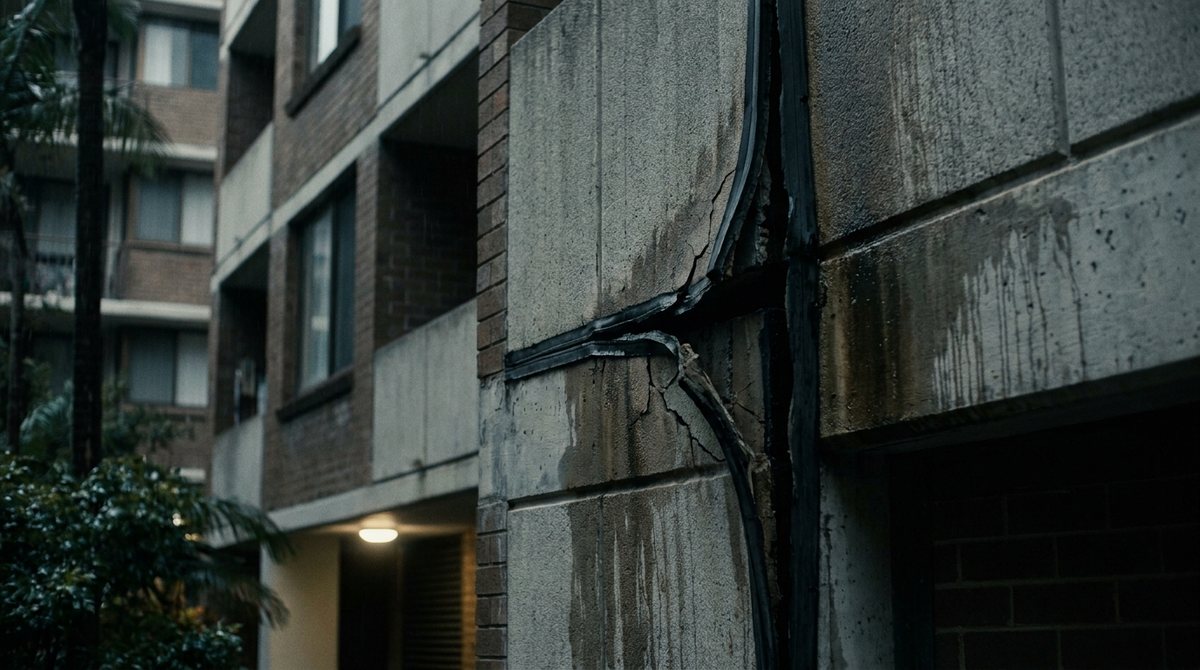
A mid-rise building in Parramatta has a vertical line running up the facade where two structural sections meet. That line is an expansion joint, and it is there on purpose, it lets the building move with temperature and load without the concrete and render cracking. When the joint is working, you barely notice it. When the seal in it fails, water gets in, the joint stops doing its job, and the cracking it was designed to prevent starts happening anyway.
An expansion joint is a designed gap that lets a building breathe. The seal is what keeps the weather out of the gap.
Why buildings need expansion joints
A building expands and contracts. Temperature swings move the structure, concrete shrinks as it cures and moves with thermal cycling for its whole life, and the building deflects under load. A long or large building cannot absorb all of this movement within a single rigid structure, so it is divided into sections with expansion joints between them, deliberate gaps that let each section move independently without forcing the movement into the concrete as cracking.
The joint runs through the structure, the facade, and the finishes. It has to do two contradictory things, allow significant movement, and keep the weather out. That is achieved with a joint system, a backing material, a movement-capable sealant or a proprietary joint seal, and often a cover detail, all designed to flex with the joint while keeping it watertight.
Why the joint seal fails
The seal in an expansion joint takes more movement than almost any other joint in the building, because the joint exists specifically to accommodate large movement. That puts heavy demand on the sealant. A sealant of insufficient movement class, the class 25 question, fails quickly because it cannot stretch and compress through the joint's full range. Even an appropriate sealant has a service life and eventually hardens, loses adhesion, and tears.
When the seal fails, water enters the joint and reaches whatever is behind it, the structure, the cavity, the internal finishes. On a facade expansion joint, the water tracks into the wall, corrodes embedded steel, damages internal linings, and surfaces inside along the joint line. And because the joint is no longer sealed, debris and movement can damage the joint faces, so the longer it runs failed, the more the rectification has to address.
Why you cannot just fill the joint solid
The instinct on a leaking joint is to pack it and seal it solid to stop the water. On an expansion joint, that is the one thing you must not do. Filling the joint with a rigid material removes its ability to move, and the building movement it was absorbing now has nowhere to go, so it forces into the adjacent concrete and render as cracking, exactly the failure the joint existed to prevent. Plenty of expansion joints have been wrongly filled solid, and the result is fresh cracking alongside the joint within a season or two.
The joint has to be repaired as a moving joint. That means restoring a joint system that flexes, the right backing, the right movement-class sealant or proprietary seal, designed for the joint's actual movement range, not packing it rigid.
What the rectification involves
A proper expansion joint rectification means removing the failed seal and any debris from the joint, assessing and repairing the joint faces if the water and movement have damaged them, and installing a new joint system rated for the movement, a movement-capable sealant of the correct class with the right backing, or a proprietary expansion joint seal designed for the span and movement, with the cover detail reinstated where there is one. Where the failed joint has let water corrode steel or damage finishes behind it, that gets addressed as part of the scope.
What to do next
- Identify the vertical or horizontal lines on the facade where the building is divided. Those are expansion joints, and their seals have a service life.
- On a leaking joint, never fill it solid. That forces the building movement into the concrete as cracking.
- Expect the fix to restore a moving joint system, the right class of sealant or a proprietary seal, not a rigid pack.
- Address any steel corrosion or finish damage behind a joint that has been leaking for a while.
How Supcon handles this
Thomas repairs the expansion joint as a moving joint. The failed seal and debris come out, the joint faces get assessed and repaired, and a new joint system rated for the actual movement goes in, the correct movement-class sealant with proper backing, or a proprietary expansion joint seal, with the cover detail reinstated. Any corrosion or finish damage behind the failed joint is addressed in the scope.
An expansion joint has to keep moving, so it gets repaired to keep moving. See sealant movement classes for the seal logic behind it, and the facade repair service page for the technical detail.
Get a remedial scope. Send through the issue.