Facade defects in Sydney apartments built 2005 to 2015: the common patterns
Render cracks at slab edges, sealant joints letting weather past, paint failing across whole elevations. A field guide to facade defects in Sydney's mid-rise strata stock.
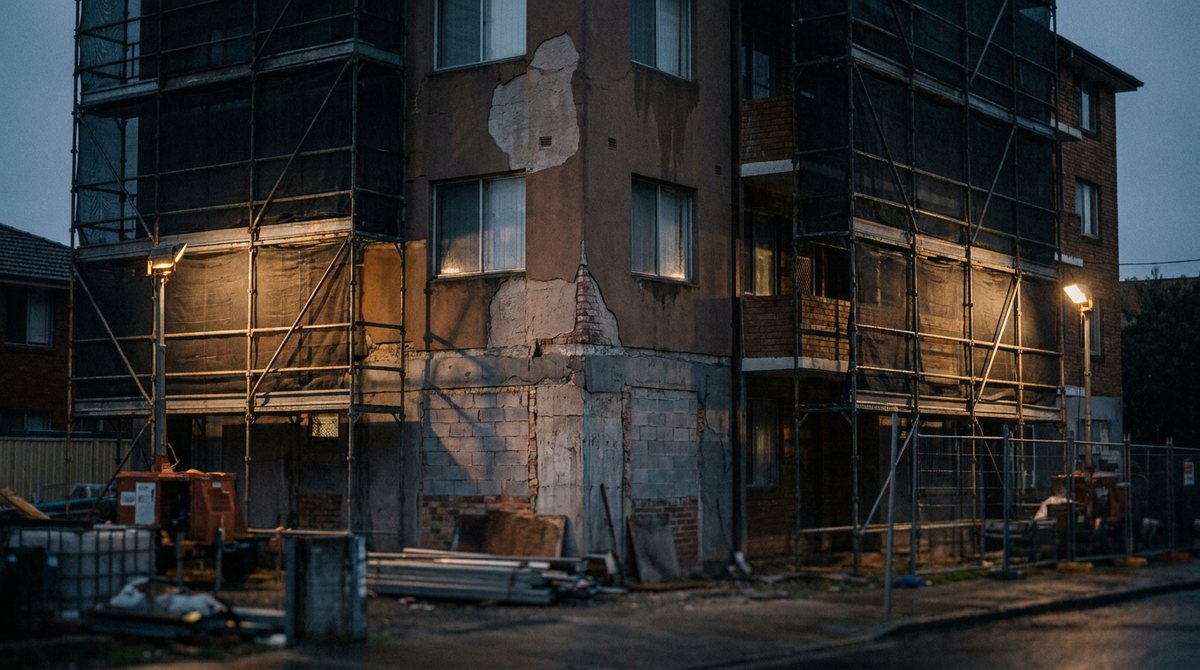
Walk along a row of mid-rise strata buildings in Mascot, Wolli Creek, Rhodes, or Olympic Park, and the same facade defects show up at roughly the same age across the lot. Render cracks running along slab edges. Sealant joints hardened and pulled away. Paint chalking and peeling at the south-facing elevation. A render panel bubbled away from the substrate, now a hollow box waiting to fall.
These are not isolated incidents. They are a generational defect wave moving through Sydney's 2005 to 2015 apartment boom. Same era, same materials, same workmanship pressures, same failure curve.
Why this era fails on this timeline
Three pressures hit the 2005 to 2015 build run at once.
Build pace was high. Sydney's apartment market saw the largest construction surge in decades from 2005 onward, peaking in the mid-2010s. Speed put pressure on detailing. The facade systems that needed careful primer, careful sealant detailing, and careful flashings got installed at speed. Materials were value-engineered. Render systems specified to budget rather than performance. Sealants chosen on a basis other than UV resistance and movement capability.
External exposure has had ten to twenty years to do its work. UV degrading the paint. Thermal cycling working the cracks. Salt air corroding the embedded wall ties on coastal stock. Movement at the slab edges working the render-substrate bond. By year twelve to fifteen, the value-engineered facade systems are at end of life. By year fifteen to twenty, the failures are visible from the street.
Pattern 1: render cracks along slab edges
The most common facade defect on this stock. The render is bonded to a substrate that includes both masonry and the slab edge. Masonry and concrete move at different rates with thermal expansion and load. The render at the joint cracks, predictably, along a horizontal line that follows the slab.
Surface response, fill the crack and paint over. Lasts twelve to twenty-four months before the crack reopens with the next thermal cycle. Proper response, the crack is a movement joint that was never detailed as one. Rout out the render along the slab edge, install a proper expansion joint with backing rod and class 25 sealant, then reinstate the render to the joint detail. Done once, the crack does not return.
Pattern 2: sealant joints letting weather past
The vertical sealant joints between facade panels, around windows, and at slab edges are typically silicone or polyurethane installed at construction. Lifespan is ten to twenty years depending on UV exposure and grade. Lower-grade sealants in exposed positions fail at the bottom of that range.
The failed sealant hardens, separates from one or both edges, and lets water past. The water reaches the substrate, sits in the cavity, and either corrodes the wall ties (visible as rust staining on the render below) or surfaces inside as a leak at the wall lining. Surface response, caulk over the failed joint. It bonds to neither edge properly because the old residue is still there, and fails within months. Proper response, rake out the entire failed sealant to the substrate, clean the edges, install backing rod to the correct depth, prime if the manufacturer requires it, install new class 25 sealant per spec, tool to a concave profile. Done correctly, this holds another fifteen to twenty years.
Pattern 3: paint failing across whole elevations
Paint fails in stages. Chalking first (a fingertip across the surface comes away white). Then loss of adhesion in patches. Then blistering. Then peeling. The pattern progresses fastest on south-facing elevations and on elevations facing the prevailing wind.
Surface response, pressure-clean and repaint over the existing system. The new paint inherits the failed adhesion of the old and peels within twelve to thirty months across the same patches. Proper response, strip the failed system back to substrate, address any render delamination underneath, reinstate with a full paint system (primer, build coats, top coats) per the manufacturer's spec. Sometimes the elevation needs full re-rendering first. The scope spells out which.
Pattern 4: render delamination at specific panels
A render panel sounds hollow on tap. The render is no longer bonded to the substrate. Eventually it falls. Falling render from a fifth-floor facade is a public-liability incident waiting to happen. Common cause, original render over a substrate that was not properly prepared, applied at the wrong thickness, or with a bond unsuited to the substrate type.
Surface response, patch the visible section, and ignore the rest of the elevation on the same bond-failure curve. Proper response, hammer-tap survey across the full elevation to find every drummy panel, break out the delaminated sections to sound substrate, reinstate render per the manufacturer's specified method with fibre mesh reinforcement at vulnerable joints, finish to match the surrounding texture.
What to do next
- Walk the building with a hammer or a coin. Tap render along slab edges, around windows, and at corners. Drummy spots are panels at risk of delamination.
- Get a sealant inspection when the building reaches twelve to fifteen years old. Failed sealants are the simplest defect to rectify before they let water in long enough to damage the substrate.
- Refuse paint-only work on chalking or peeling elevations. The substrate work has to happen first.
- Get the building consultant involved if the defects are widespread. A consultant's report gives the OC a defensible third-party assessment to attach to the AGM motion.
How Supcon handles this
Thomas walks the facade, runs the hammer-tap survey across the elevation, inspects every sealant joint, tests paint adhesion, and writes the scope against the actual defect map. The scope covers render rectification to AS 3700 where masonry is involved, sealant reinstatement to the class 25 standard where movement joints are involved, and the paint system strip-and-rebuild where the substrate is sound but the paint has failed.
Scope is staged by elevation so the building is not under scaffold on all four sides at once. See sealant movement classes for the joint detail, and the facade repair service page for the technical detail.
Get a remedial scope. Send through the issue.