Why the source-fix outlasts the patch
A patched Hurstville balcony returns as a structural rectification inside five years. Here is the progression an Owners Corporation needs to read before approving any surface repair.
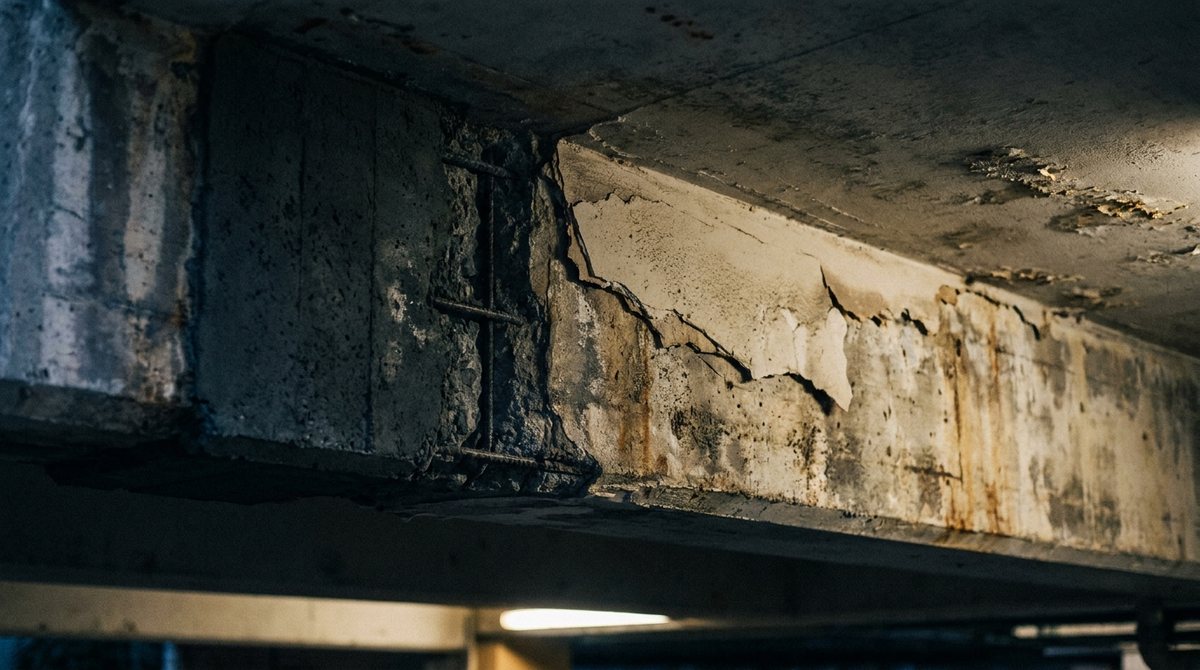
A patched leak on a Hurstville balcony comes back as a structural rectification inside five years. The surface repair looks like the simple call on the day. By the time the membrane has failed twice, the slab below has carbonated, the apartment underneath has water damage, and the committee is asking why three contractors could not stop the same leak, the building is past the point where surface work was ever going to hold.
This is the progression Owners Corporations misread every quarter.
What a surface repair actually addresses
A surface repair almost never names the source. A contractor turns up, looks at the wet patch on the apartment ceiling, recoats the balcony tile or recaulks the perimeter, and signs off on the visible joint. The water keeps coming in. It is just tracking through a different cavity for a while.
Six months later the stain reappears. The strata manager calls back. The contractor blames new movement or another failure point. A second recoat goes on. Another twelve months pass. By year three the membrane underneath is a decade past end of life, the screed has been wet long enough for the steel to start oxidising, and the apartment below is on its second insurance claim. The maintenance contractor's scope ended at the visible joint. The membrane was never part of it. That is not bad work. It is a different category of work.
What the source-fix does instead
Remedial starts where the water is entering the building, not where it surfaces. On a Bondi balcony that means lifting the tiles back at three or four points to confirm whether the membrane has failed at the hob, the perimeter, or the drainage falls. Sometimes it is all three. The scope of works names the cause, specifies the fix to AS 4654.2, and covers the membrane replacement across the whole deck rather than the visible patch.
The work is done once. The next ten years run without resident complaints, without insurance claims, without three more contractors on the same problem.
The structural progression an OC needs to read
Take the same balcony. Hurstville, 2008 strata, membrane original. Two paths.
Path one, surface repairs. Year one, a recoat over the failed system. Year two, the leak returns and another recoat goes on. Year three, the leak returns again, and by now the slab is starting to spall at the edge. Year four, the spalling has spread far enough that a structural assessment is needed, because what began as a wet ceiling is now a reinforcement-corrosion problem in the slab. Year five, a full rectification is unavoidable, and it now carries concrete cancer repair the original leak never required.
By year four the slab is a structural call, not a surface repair. That is the line every patch crosses if the source is left running. The damage compounds in one direction only, and it never gets smaller while it waits.
Path two, the source-fix in year one. The membrane is replaced to AS 4654.2 with the right turn-ups at the hob and the perimeter, the falls are corrected, the tiles relaid. Years two through five run with no calls. The slab never carbonates because the water never reaches it. The structural progression simply never starts.
What to do next
- Get the source named in writing before approving any repair. If the scope does not name the membrane failure point, the hob upstand, or the drainage detail, the work is not remedial.
- Ask for the AS code the membrane will be installed to. AS 4654.2 for external above-ground, AS 3740 for internal wet areas. If the contractor cannot name the standard, walk.
- Frame the decision to the committee as a progression, not a comparison of two repairs. The question is whether the slab stays a surface job or becomes a structural one.
- Get the scope of works as a separate document. The committee should be able to read the scope and explain it back. If they cannot, it is not a defensible scope.
How Supcon handles this
Supcon scopes the source first. Site walk, moisture mapping, lift the tiles where the failure points are, write the scope of works against the actual defect, then deliver. The scope tells the OC exactly what each line of work addresses. There is no surface-only option offered, because Supcon does not patch. The work is done once.
If the budget genuinely will not stretch to a full rectification this financial year, the scope can be staged so the source-fix happens first and the cosmetic finish follows. What does not happen is taking on a patch that we know will fail. See why three remedial scopes for the same building look nothing alike for how to read a real diagnosis scope, and the waterproofing and membrane service page for the technical detail.
Get a remedial scope. Send through the issue.