Why your planter box keeps leaking into the apartment below
Planter box failures are Sydney's highest-stakes remedial category. A building-wide scope sounds steep until you read the third call-back. Here's why the membrane keeps winning.
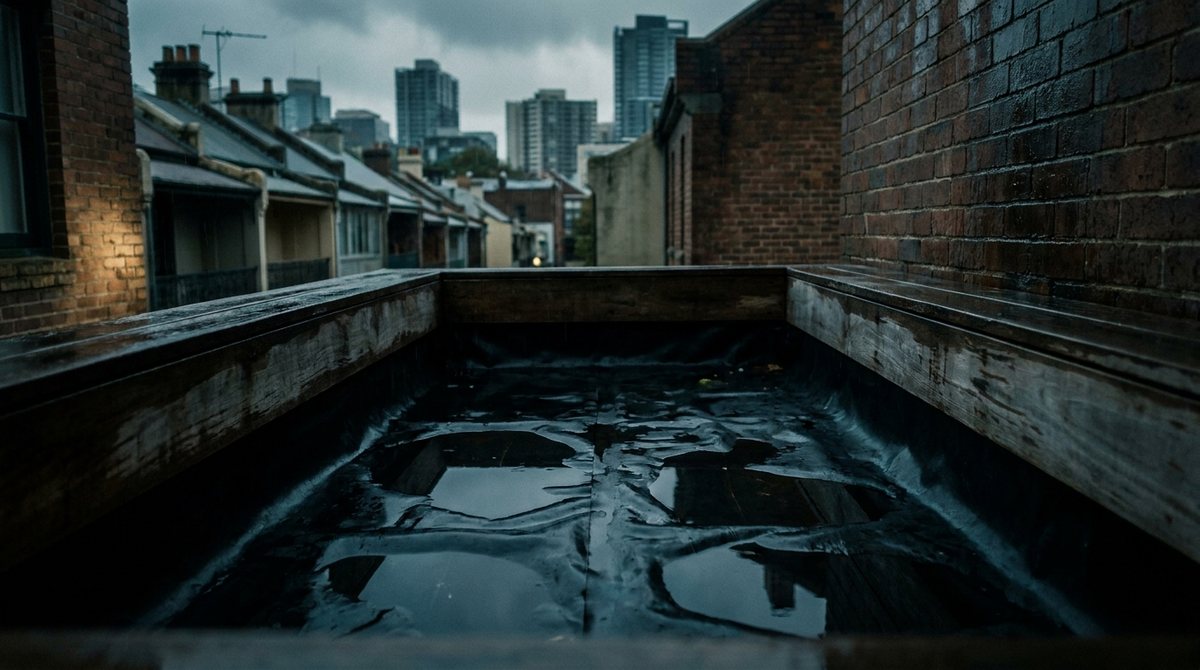
Surry Hills, 2009 build, podium-level planter box running thirty metres along the south facade. The membrane has been failing slowly for eight years. The apartment below has had its ceiling repainted three times. The committee has approved two surface repairs. The leak is back. The third scope, this time for a full rectification, is in front of them, and the committee is asking why the building cannot just top up the soil again.
This is the planter box failure pattern across Sydney's 2005 to 2015 podium-deck strata stock.
Why planters are the highest-stakes failure point
A planter box is a structural element holding wet, weighted soil against a slab. The soil is wet most of the time. The membrane underneath is the only thing keeping the water out of the apartment below. Membranes were never designed to last forever, and the ones installed from 2005 through 2015 were typically value-engineered to the spec of the day, not over-specified for a thirty-year service life.
By year eight to twelve, the membrane starts giving way at the perimeter, the drainage outlet, or the wall-floor junction. By year twelve to fifteen, it has failed somewhere along the run. Water tracks through the substrate, picks the path of least resistance, and surfaces in the apartment under the failure point. The failure rarely shows up in the planter. It shows up in someone's bedroom ceiling.
Why the surface repair never holds
The standard sequence. Strata calls a maintenance contractor. The contractor looks at the planter, sees no obvious damage, refills the top six inches of soil, recoats the visible exposed concrete edge, and leaves. The membrane is fifteen centimetres below the soil. It is still failed. Water is still tracking. The leak in the apartment below returns inside six months.
Topping up the soil does nothing to the membrane. Sealing the drain outlet does nothing to the membrane. Replacing the topsoil and the plants does nothing to the membrane. The only fix is emptying the planter to the substrate, addressing the membrane and the drainage system, then reinstating the planting build-up from scratch.
What a proper planter rectification involves
Empty the planter. Plants out (lifted and stored where the species allows, replaced otherwise). Soil out. Root barrier out. Drainage cell out. Protection board out. The planter is empty to the substrate.
Inspect the substrate. Almost every planter that has been wet for years has concrete spalling at the slab edge, because the reinforcement at the planter perimeter has sat in moist conditions for a decade. Hammer-tap survey across the slab, repair to sound concrete, treat the steel, reinstate the cover with polymer-modified mortar to AS 3600.
Falls and drainage. Original falls inspected, drain outlet checked. Often the outlet is undersized for the planter run, or the falls have flattened with substrate movement, so the membrane has been sitting under standing water for years. New screed, corrected falls, upgraded outlet. Detail every junction, wall-floor, planter perimeter, drain penetration, all primed and reinforced with fabric per AS 4654.2.
Install the membrane. Liquid-applied polyurethane or sheet system, root-resistant grade, two-coat to manufacturer's spec. Flood test before backfill to verify integrity. Then reinstate the build-up, protection board, drainage cell, root barrier, filter fabric, planting mix, plants, to the original spec or upgraded if the original failed early.
Why the building-wide scope is the right call
A 2009 strata building with five planter boxes along the podium typically has the same membrane spec across all five. Same era. Same installer. Same exposure. When one fails, the others are eighteen to thirty months behind.
Scoping one planter at a time means returning to scaffold, access platforms, and resident disruption five separate times across the next decade. Each return carries its own mobilisation and access setup, and each interval is more water through the slab and more damage to the apartment below. The building-wide program does it in one access setup, one membrane order, one trade run, before the planters that have not failed yet get the chance to. The committee sees one larger scope. The alternative is the same work done five times over a decade with the structural damage compounding in between.
What to do next
- If one planter has failed, get the whole planter run scoped at once. Do not approve a single-planter scope until the building consultant has confirmed the others are not on the same failure timeline.
- Demand the substrate inspection in the scope. Most planter rectifications need a concrete cancer sub-scope at the slab edge. Without it, the rectification is incomplete.
- Get the root-resistant membrane grade specified by manufacturer and product name. Generic waterproofing is not a planter spec.
- Make sure the scope includes the flood test before backfill. Without it, the rectification has no proof of integrity at handover.
How Supcon handles this
Thomas walks the building, inspects the planters at the perimeter, the drain outlet, and the soil-line, and takes a moisture map from the apartment underneath. The scope covers the empty-out, the substrate inspection, the concrete cancer rectification if needed, the falls correction, the membrane installation to AS 4654.2, the flood test, and the reinstatement.
A building-wide planter program is not a sales line. It is what a podium-deck rectification involves when it is done properly, once. See podium and planter box failures on 2010s developments for the era pattern, and the planter box remediation service page for the technical detail.
Get a remedial scope. Send through the issue.