1960s to 1980s walk-up render fatigue across Sydney
Sydney's red-brick walk-up flats from the 1960s to 1980s share a render fatigue pattern. Cracked and drummy render, spalling balconies, tired concrete. Here's what that older stock needs.
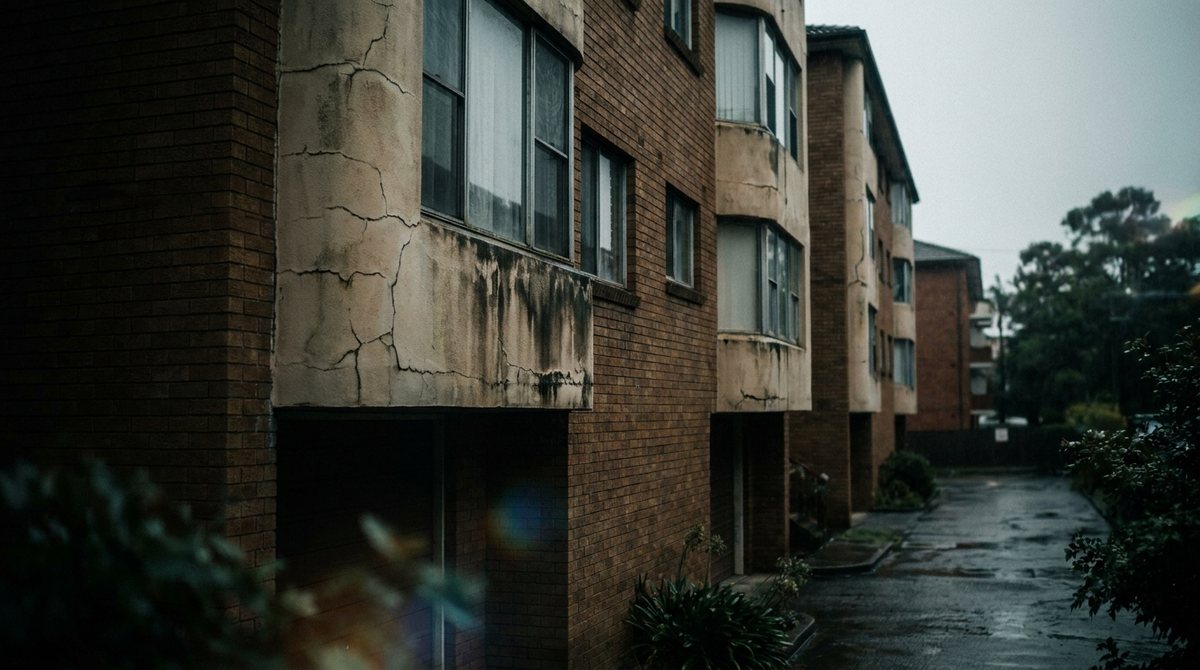
The three-storey red-brick walk-up is one of Sydney's most common building types. Kingsford, Kensington, Randwick, Lakemba, Hurstville, tens of thousands of them went up between the 1960s and the 1980s. They have aged well in the structure and tired badly in the render and the exposed concrete. The defect pattern on this stock is its own thing, different from the glass-and-render towers of the 2000s, and it needs an approach matched to older, simpler, but now genuinely weathered construction.
The walk-up is sound bones with a tired skin. The render and the balcony edges are where the age shows.
What the walk-up was built like
The typical Sydney walk-up of this era is load-bearing brick or brick-and-concrete, three storeys, no lift, with a rendered finish on parts of the facade and exposed concrete balconies and walkways. The construction was solid and relatively simple. There was no waterproofing membrane technology of the kind used on modern decks, and the concrete cover specifications of the day were modest.
Fifty to sixty years on, the structure is generally still sound, but the render has fatigued, the exposed concrete balconies and walkways have weathered, and the original detailing, parapets, balcony edges, walkway slabs, has had decades of water working on it.
Pattern 1: render fatigue and delamination
The render on a walk-up of this age has been through sixty years of thermal cycling, moisture, and movement. It cracks along stress lines, loses its bond in patches, and on tap, sounds increasingly drummy across the elevation. Old repairs sit alongside original render, often in incompatible mixes, which creates new stress lines at the junctions.
The compatibility issue from older brick applies in full. Hard cement patches over the original softer render and brick fail at the interface. A proper render rectification on this stock means a hammer-tap survey of the whole elevation, removal of the delaminated and incompatible material, and reinstatement with a render matched to the substrate, breathable, and no stronger than the brick beneath.
Pattern 2: spalling balcony and walkway edges
The exposed concrete balcony fronts and the walkway slabs are the most weathered elements. With modest original cover and no membrane, water has had sixty years to reach the reinforcement at the edges. The result is spalling along balcony fronts, walkway slab edges, and the exposed nosings. On coastal walk-ups, Kingsford, Maroubra, Coogee, salt air has driven chloride attack into these edges.
The rectification is concrete repair to AS 3600, break out to sound steel, treat the reinforcement, reinstate the cover with polymer-modified mortar, and protect the surface. On coastal stock, the chloride question and the case for anodes apply just as they do on newer buildings. The age of the building does not change the chemistry, it just means the process has been running longer.
Pattern 3: parapet and waterproofing-detail failures
Walk-up parapets, balcony slabs, and walkway surfaces were waterproofed, where they were waterproofed at all, with the technology of the time. Those details have long since reached the end of their service. Water enters at the parapet capping, the walkway-to-wall junction, and the balcony surface, and tracks into the structure. A remedial programme on this stock usually includes re-establishing these waterproofing details to current standards, AS 4654.2 for the exposed decks and walkways.
What to do next
- On a walk-up of this era, get a full-elevation hammer-tap survey of the render. Drummy patches are the map of what needs reinstating.
- Expect spalling at balcony fronts and walkway edges. Modest original cover plus sixty years of water is the cause.
- On coastal walk-ups, expect chloride attack at the exposed edges, and ask whether anodes belong in the repair.
- Match any new render to the old brick. Hard cement over soft brick fails at the interface.
How Supcon handles this
Thomas surveys the render across the full elevation, removes the delaminated and incompatible material, and reinstates with a render matched to the older brick. The spalling balcony and walkway edges get concrete repair to AS 3600, with the chloride question assessed on coastal stock. The weathered waterproofing details are re-established to AS 4654.2.
The walk-up rewards an approach matched to its age, not a modern-tower template. See render systems and substrate compatibility for the render-matching detail, and the facade repair service page for the technical detail.
Get a remedial scope. Send through the issue.