AS 3740 wet area compliance in apartments
An apartment bathroom leak into the unit below is an AS 3740 failure. The standard governs internal wet-area waterproofing. Here's what compliant detailing actually looks like.
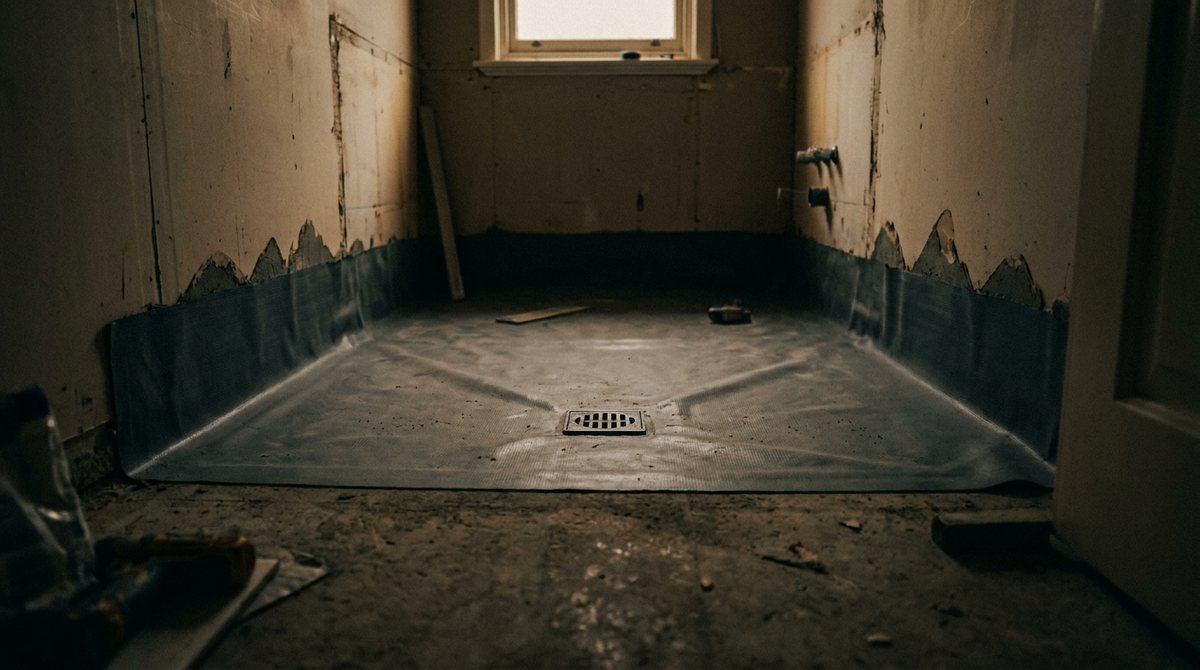
A Pyrmont apartment owner reports water staining on the ceiling below their bathroom. The bathroom looks fine. The tiles are intact, the silicone is recent, nothing is visibly wrong. The failure is under the tiles, in the waterproofing membrane, and it is an AS 3740 problem. Internal wet areas have their own standard, separate from external work, and the detailing it requires is where most apartment bathroom leaks are won or lost.
The bathroom that looks perfect can be the one leaking into the unit below.
What AS 3740 governs
AS 3740 is the Australian Standard for waterproofing of domestic wet areas, bathrooms, ensuites, laundries, and the like. It is the internal counterpart to AS 4654.2. It sets where the waterproofing membrane has to go, how high it has to turn up the walls, how it has to be detailed at the floor-wall junction, at the shower, at penetrations, and at the door.
In an apartment, the stakes are higher than in a house, because the floor below the wet area is someone else's ceiling. A house bathroom leak damages the owner's own subfloor. An apartment bathroom leak damages the neighbour's ceiling, triggers a strata claim, and becomes an Owners Corporation matter. The standard is the same. The consequence of a failure is shared.
Where AS 3740 detailing matters most
The floor-wall junction is the first. The membrane has to be continuous from the floor up the wall, with no break at the corner, because the corner is where water collects and where movement concentrates. A membrane that stops at the floor and a separate one that starts on the wall, lapped imperfectly at the junction, is a classic failure point.
The shower area requires the most. AS 3740 sets the membrane extent and the wall turn-up height in the shower, higher than the rest of the bathroom, because the shower is the wettest zone and the water hits the walls directly. The hob or the step-down at the shower, the floor waste, and the tap and outlet penetrations all require specific detailing. The door threshold needs a turn-up to stop water migrating out of the wet area into the adjoining floor.
Why apartment bathrooms fail on this timeline
Sydney apartment bathrooms from the 2000 to 2015 build run carry the same pressures as the external work. Value-engineered membrane systems. Detailing done at speed. Floor wastes and penetrations finished quickly. The membrane performs for a decade or so, then a junction or a penetration that was always marginal lets go, and the water finds the unit below.
A common pattern is the membrane that was applied too thin, or skipped the turn-up at a penetration, or terminated short at the door. None of it is visible once the tiles are on. The bathroom presents as sound for years. The leak appears below, not in the bathroom, which is why owners are often convinced their bathroom is fine while it is the source.
What a compliant rectification involves
An AS 3740 rectification means lifting the floor tiles and the affected wall tiles, removing the failed membrane to substrate, repairing the substrate and re-establishing the floor falls to the waste, then installing a new waterproofing membrane to the standard, continuous at the floor-wall junctions, turned up to the required heights in the shower and at the door, and detailed at every penetration. A flood test confirms the membrane holds before the tiles go back.
Resealing the silicone or regrouting the tiles does not touch any of this. It is the bathroom equivalent of a balcony recoat, cosmetic work over a membrane failure, and it fails on the same timeline.
What to do next
- On a leak into the unit below a bathroom, suspect the membrane, not the silicone. Resealing the surface does not fix an AS 3740 membrane failure.
- Ask for a scope that lifts tiles, replaces the membrane to AS 3740, and re-establishes the floor falls to the waste.
- Confirm the scope details the shower turn-up height, the floor-wall junctions, and every penetration.
- Confirm a flood test before tile reinstatement. It is the proof the membrane holds.
How Supcon handles this
Thomas diagnoses the wet-area leak to the membrane, not the surface, and writes the scope to AS 3740. Tiles up, failed membrane out, substrate and falls re-established, new membrane continuous at the junctions and turned up to the standard in the shower and at the door, every penetration detailed, flood-tested before reinstatement.
The standard governs the detailing, and the detailing is where the leak is won. See window head and sill leak patterns for the other common apartment water entry, and the leaking bathroom and window rectification service page for the technical detail.
Get a remedial scope. Send through the issue.