AS 4654.2 falls and drainage explained
Most balcony membranes fail because the water sits, not because the product was wrong. AS 4654.2 sets the falls and drainage that keep water moving. Here's what the standard requires.
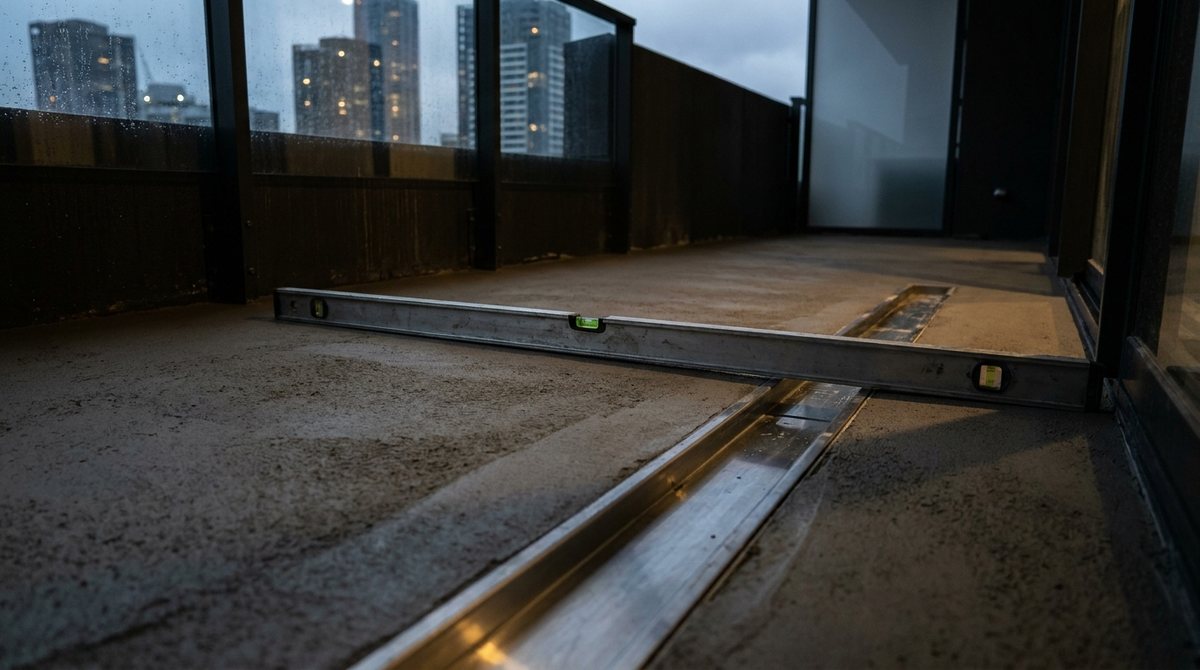
A 2011 Chatswood balcony was waterproofed with a perfectly good membrane and still leaks. The product was not the problem. The deck was laid close to flat, the water pools after every storm, and a membrane sitting under standing water eventually finds its weakest detail and lets the water through. AS 4654.2 exists to stop exactly this. The falls and the drainage are half the waterproofing, and they are the half most often skipped.
A membrane keeps water out. Falls and drainage make sure the water never gets the chance to sit and test it.
What AS 4654.2 covers
AS 4654.2 is the Australian Standard for waterproofing of domestic and commercial buildings, external above-ground. It governs balconies, terraces, podiums, planter boxes, and any external surface over occupied space. It sets the requirements for the membrane, yes, but critically it sets the requirements for the things around the membrane that make it work, the falls, the drainage, the upstands, and the penetrations.
Falls: why the water has to move
The standard requires a minimum fall toward the drainage points so water sheds rather than ponds. The principle is simple. Standing water is the enemy of any membrane. It finds every pinhole, every thin spot, every imperfect detail, and it has unlimited time to do it. A deck that drains in minutes barely tests the membrane. A deck that holds a puddle for days after rain tests it constantly.
On a remedial job, the original fall is often the root cause. A deck laid close to flat at construction, or one where the screed has flattened with substrate movement over fifteen years, holds water no matter how good the new membrane is. This is why a proper rectification almost always re-establishes the falls with new screed before the membrane goes back. Relaying the membrane on the old flat screed just repeats the original mistake with a fresh product.
Drainage: where the water goes
Falls move the water. Drainage takes it away. AS 4654.2 requires drainage points sized and positioned to clear the water the falls deliver. On a balcony that means a drain or a weep detail at the low point. On a planter box it means a drainage layer above the membrane and an outlet sized for the planter run. On a podium it means a drainage system under the surface build-up.
The common failures are an undersized outlet, an outlet positioned away from the actual low point because the falls were never set to it, and a drainage layer that has clogged or collapsed. A membrane with nowhere to send the water it sheds is a membrane sitting in a bathtub. The standard ties the falls and the drainage together for this reason. One without the other does not work.
Upstands and penetrations: where leaks actually start
AS 4654.2 sets minimum upstand heights at junctions, door thresholds, walls, and hobs. The upstand is the vertical turn-up of the membrane at a junction, and its height is what stops water tracking over the top of the membrane at the edge. A door threshold with an upstand below the required height is the single most common balcony leak path. Water driven against the door under wind and rain rises above the membrane termination and tracks inside.
Penetrations, drains, balustrade fixings, service pipes, are the other classic entry. Each one breaks the continuity of the membrane and each one has to be detailed, primed, reinforced, and terminated to the standard. The membrane field can be flawless and a single un-detailed balustrade fixing will leak.
What to do next
- On any balcony leak, ask whether the deck ponds after rain. A deck that holds water has a falls problem the new membrane will not fix on its own.
- Confirm the scope re-establishes falls with new screed where the original is flat, not just a re-membrane on the old screed.
- Ask about the upstand height at door thresholds. It is the most common balcony leak path.
- Confirm the scope details every penetration to AS 4654.2, not just the open field.
How Supcon handles this
Thomas checks the falls before anything else, because the falls decide whether the new membrane gets tested by standing water or not. Where the screed is flat, the scope re-establishes the falls to AS 4654.2 with new screed. The upstands are set to the standard at every threshold and junction. Every penetration is detailed, primed, and reinforced. The deck is flood-tested to confirm the water moves to the drainage and nowhere else.
The falls and drainage are the half of waterproofing that lasts or fails. See liquid-applied versus sheet membranes for the product side, and the waterproofing and membrane service page for the technical detail.
Get a remedial scope. Send through the issue.