Liquid-applied versus sheet membranes: when each one belongs
A balcony, a planter box, and a podium deck do not all want the same membrane. Liquid-applied and sheet systems each have a place. Here's how the application decides the choice.
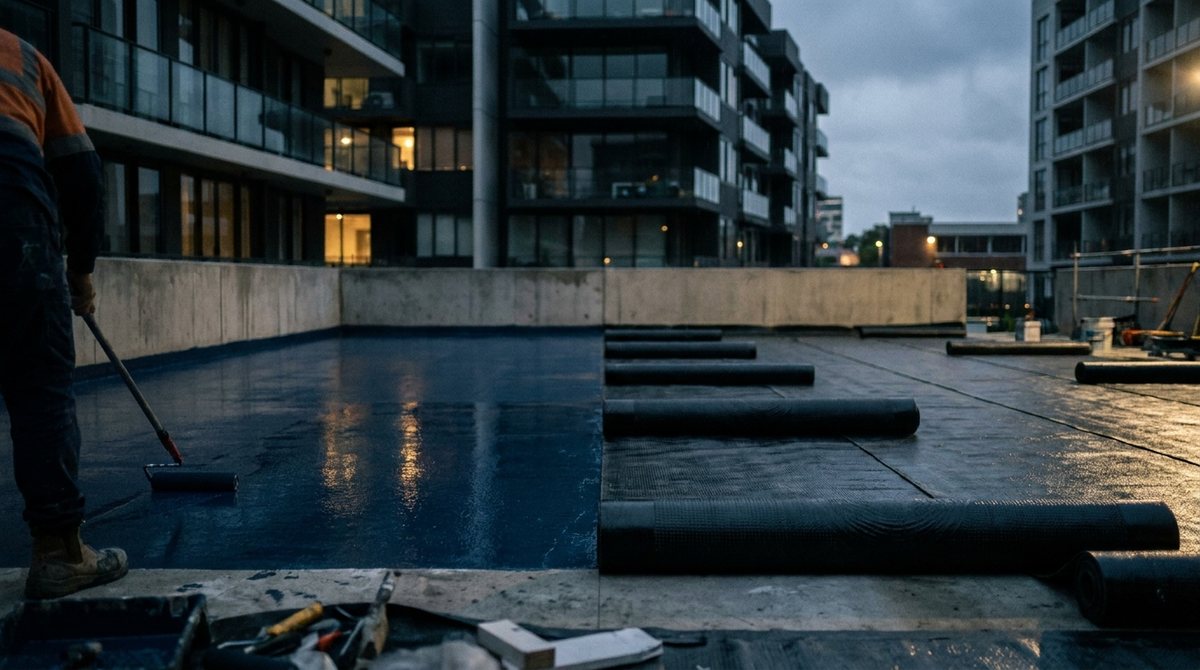
A Zetland podium deck, a balcony off a 2012 apartment, and a planter box on the same building can each call for a different waterproofing membrane. The choice between a liquid-applied system and a sheet system is not a matter of which is better in the abstract. It is a matter of which suits the substrate, the detailing, and the exposure of that particular element. AS 4654.2 sets the performance bar. The application sets the system.
Both are real waterproofing. They are not interchangeable.
What a liquid-applied membrane is
A liquid-applied membrane is exactly that, a coating applied wet and cured in place to form a continuous, joint-free film. Polyurethane and polymer-modified systems are the common types in remedial work. It is brushed, rolled, or sprayed across the substrate and into every junction, then built up to the specified thickness over two or more coats.
Its strength is the detailing. Because it is applied wet and cures as one continuous film, it follows complex geometry, internal corners, penetrations, upstands, drainage outlets, without joints. On a balcony with a hob upstand, a door threshold, a drain, and a perimeter, the liquid system wraps every detail continuously. There is no lap to fail. That is why it is the common choice for balconies and wet areas with intricate detailing. Its weakness is that it depends on application quality. The cured thickness has to hit the spec across the whole area, and the substrate has to be sound and prepared. A thin spot is a weak spot.
What a sheet membrane is
A sheet membrane is a manufactured sheet, torch-on modified bitumen, self-adhesive, or a synthetic sheet, rolled out across the substrate and lapped at the edges. The material arrives at a controlled, factory-set thickness, which is its main advantage. There is no risk of an under-applied film, because the thickness is built into the product.
Its strength is consistent thickness and durability across large, relatively simple areas. A big podium deck with long open runs is a natural fit. Its weakness is the laps and the detailing. Every overlap between sheets is a potential failure point, and complex geometry, lots of penetrations and corners, multiplies the detailing work, each detail requiring careful termination. Sheet systems also need skilled installation at the laps and upstands, where most sheet membrane failures originate.
How the application decides
A balcony with a hob, a door threshold, a drain, and a balustrade fixing is detail-heavy and area-light. The liquid-applied system usually wins, because the joint-free detailing matters more than the open-run consistency. A planter box, wet constantly and root-loaded, wants a root-resistant grade, available in both liquid and sheet, with the choice driven by the substrate condition and the junction complexity. A large podium deck with long open runs and few penetrations often suits a sheet system, for the factory-set thickness across the area, with liquid detailing at the penetrations as a hybrid.
The honest answer on many remedial jobs is a hybrid. Sheet across the open field for consistent thickness, liquid at the details for continuous, joint-free termination. The scope should say which system goes where, and why.
What AS 4654.2 requires either way
Whichever system is chosen, AS 4654.2 governs external above-ground waterproofing. It sets the requirements for falls to drainage, for upstand heights at junctions and thresholds, for the treatment of penetrations, and for the substrate condition. A membrane installed to a flat fall, or with an upstand below the required height at a door threshold, fails the standard regardless of the product. The system is only as good as the detailing the standard demands behind it.
What to do next
- On any membrane scope, ask which system is specified for which element, and why the application drove that choice.
- On detail-heavy balconies, expect a liquid-applied system or a hybrid with liquid detailing.
- On large open decks, a sheet system or hybrid is reasonable, but ask how the laps and upstands are detailed.
- Confirm the scope cites AS 4654.2 for the falls, upstands, and penetrations, not just the membrane product.
How Supcon handles this
Thomas specifies the system to the element. Continuous liquid-applied where the detailing is intricate, sheet where the open-run consistency matters, hybrid where the deck wants both. Every system is installed to AS 4654.2 for the falls, upstands, and penetrations, and flood-tested before reinstatement.
The application decides the membrane, not a default. See AS 4654.2 falls and drainage explained for the standard behind the install, and the waterproofing and membrane service page for the technical detail.
Get a remedial scope. Send through the issue.