Balcony balustrade fixing corrosion in coastal Sydney
A loose balcony balustrade on a coastal Sydney apartment is often a corrosion problem at the fixing, not a fastening problem. Here's how salt air attacks the fixing and why it is a safety issue.
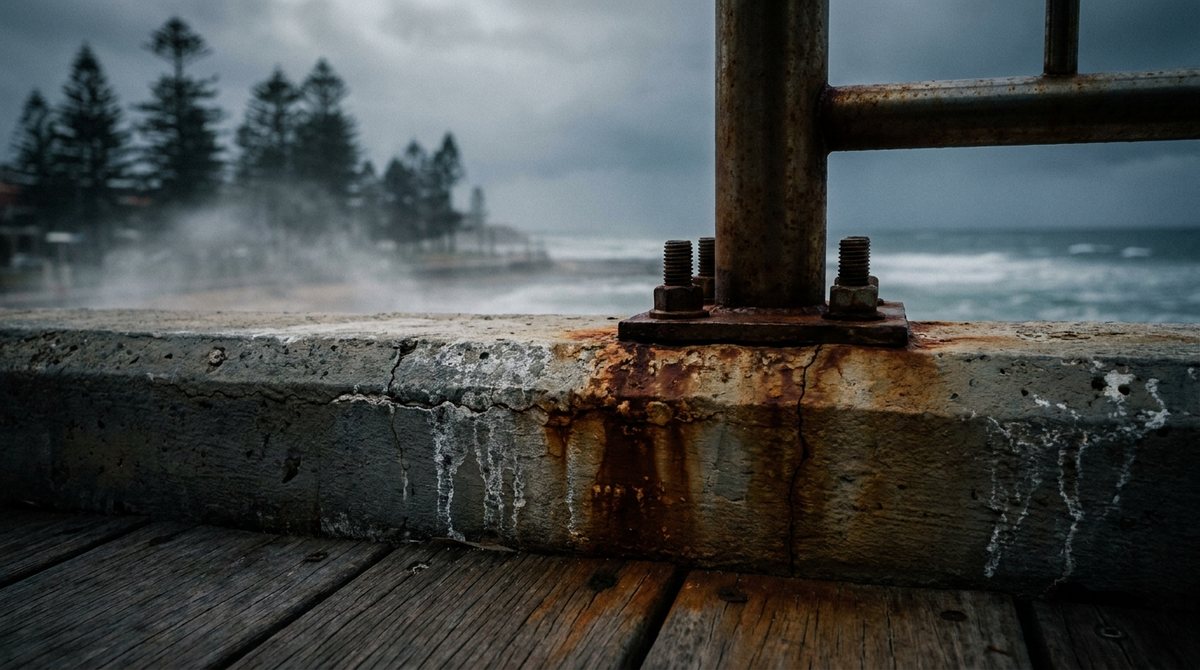
A balcony balustrade on a Coogee apartment has gone slightly loose. The owner assumes a bolt has worked free and needs tightening. On a coastal building, that is rarely the whole story. The looseness is usually corrosion at the fixing, the steel that anchors the balustrade into the concrete rusting and expanding inside the slab edge. It is a defect, and on a balustrade, it is a safety-critical one, because the balustrade is the only thing between a resident and a fall.
A loose coastal balustrade is a corrosion warning, not a tightening job. The fixing is the failure point.
How a balustrade is fixed, and where it corrodes
A balcony balustrade is anchored into the concrete, either core-drilled and grouted into the slab edge, base-plated and bolted to the surface, or cast into the original pour. The anchor is steel. On a coastal building, that steel is exposed to the same salt-laden air that drives chloride attack in the slab itself, and the fixing detail is often a concentration point for water and salt.
When the fixing steel corrodes, it does two things. It loses section, so the anchorage weakens, and it expands as it rusts, the same seven-times-volume expansion that drives concrete cancer, which cracks and spalls the concrete around the fixing. The balustrade goes loose because the concrete gripping the fixing is breaking up and the steel anchoring it is wasting away. Tightening a bolt does nothing about either.
Why coastal exposure makes this acute
The eastern suburbs and the southern beaches, Bondi, Coogee, Bronte, Maroubra, Cronulla, Manly, Dee Why, sit in a high-corrosion environment. Salt aerosol from the surf settles on every exposed surface, and balcony balustrades are about as exposed as a building element gets, projecting out into the weather on the seaward face.
The fixing detail often traps salt and water exactly where the steel enters the concrete. Where the original fixing used a steel grade not suited to a marine environment, or where the concrete cover over the fixing anchor was thin, the corrosion is fast. Balustrade fixings on a beachside building can be significantly corroded within a couple of decades, well before the rest of the structure shows its age.
Why this is a safety issue, not a cosmetic one
A balcony balustrade has one job, to stop a person going over the edge. The relevant loadings under the building code assume the balustrade is properly anchored. A balustrade whose fixings are corroded has lost some unknown fraction of its anchorage capacity. It may hold under normal use and fail under a sudden load, someone leaning, a crowd, a child. This is why a loose coastal balustrade is treated as a safety defect and inspected properly, not nudged back into place.
What the rectification involves
A proper balustrade fixing rectification means exposing the fixing, assessing the corrosion to the anchor and the concrete around it, and reinstating both. Break out the spalled and cracked concrete around the fixing, treat or replace the corroded fixing with a grade suited to the marine environment, often stainless steel of an appropriate grade for the exposure, re-anchor it properly, and reinstate the concrete cover. Where the corrosion has spread along the slab edge, it merges into a balcony concrete cancer scope.
Because the balustrade fixings on a coastal building tend to corrode together, the responsible approach assesses all the fixings on the elevation, not just the one that went loose. The loose one is the first to announce itself. The others on the same exposure are usually not far behind.
What to do next
- Treat a loose balustrade on a coastal building as a corrosion and safety defect, not a tightening job.
- Get the fixing exposed and assessed, the anchor and the concrete around it, before anyone leans on it again.
- Expect the fix to use a fixing grade suited to the marine environment, not a like-for-like replacement that corrodes again.
- Assess all the balustrade fixings on the elevation. They corrode on the same clock.
How Supcon handles this
Thomas treats a loose coastal balustrade as a safety-critical corrosion defect. The fixing is exposed and assessed, the spalled concrete broken out, the corroded anchor replaced with a grade suited to the marine exposure, re-anchored, and the cover reinstated to AS 3600. Where the corrosion has run along the slab edge, the scope merges into balcony concrete repair, and all the fixings on the elevation are assessed together.
On a balustrade, the fixing is the difference between a railing and a hazard. See eastern suburbs salt-air corrosion for the wider coastal picture, and the balcony rectification service page for the technical detail.
Get a remedial scope. Send through the issue.