Eastern suburbs salt air corrosion in apartment blocks
Bondi, Bronte, and Coogee put apartment blocks in the harshest corrosion environment in Sydney. Salt air drives concrete cancer and metal corrosion. Here's what eastern beaches stock needs.
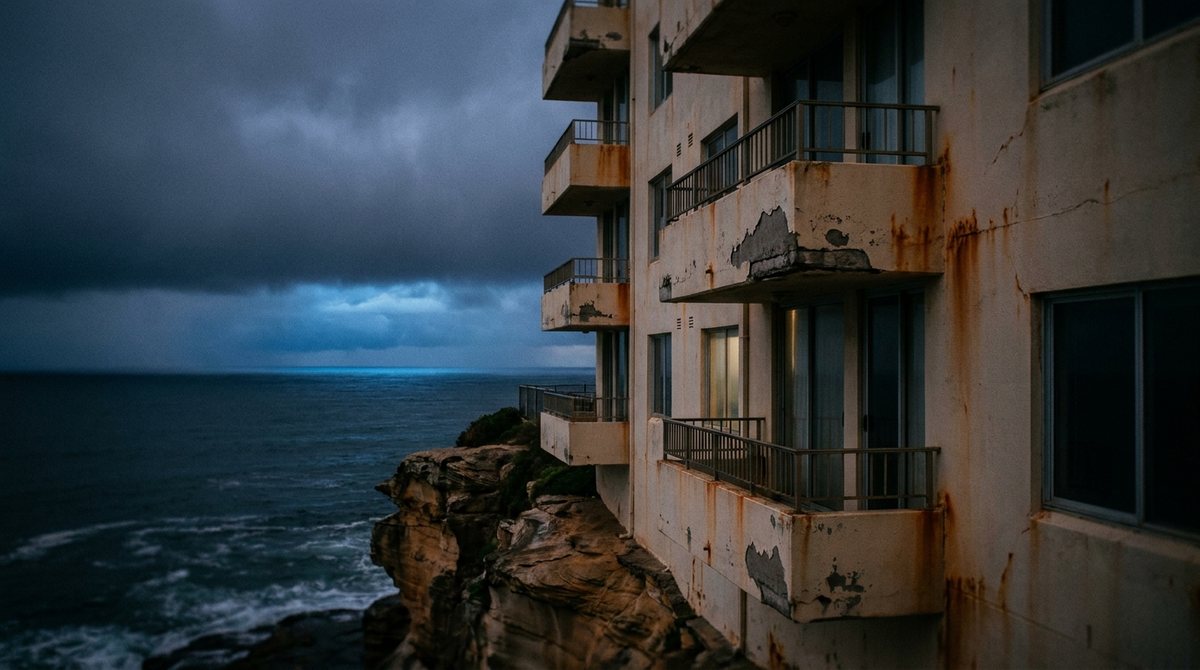
A Bondi apartment block a hundred metres from the beach is fighting a battle most Sydney buildings never face. The eastern beaches, Bondi, Tamarama, Bronte, Coogee, Clovelly, sit in the harshest corrosion environment in the city, where salt aerosol off the surf coats every exposed surface, every day, year after year. On these buildings, concrete cancer and metal corrosion are not occasional defects. They are the defining maintenance reality, and the stock needs an approach built around salt.
On the eastern beaches, salt is relentless. Concrete cancer and corrosion are the permanent condition, not the exception.
Why the eastern beaches are the harshest environment
The eastern beaches face open ocean surf, and breaking waves generate a fine salt aerosol that the prevailing winds carry inland and deposit on everything. Buildings on the beachfront and the streets behind sit in this salt-spray zone continuously. The salt loading is among the highest any building stock in Sydney experiences, and it does not let up.
Salt accelerates two destructive processes at once. It drives chloride attack in reinforced concrete, the most aggressive form of concrete cancer, and it corrodes exposed metal, fixings, railings, fasteners, balustrades, far faster than an inland environment would. An eastern beaches building is under sustained chemical attack on both its concrete and its metalwork.
Concrete cancer on the eastern beaches
Concrete cancer here is overwhelmingly chloride-driven. The chloride penetrates the cover, breaks down the steel's passive layer, and drives deep pitting corrosion. The most exposed elements, balcony slabs and soffits, parapets, exposed slab edges, fail first, and the seaward elevations take the worst of it. Buildings here can show significant concrete cancer earlier in their life than sheltered inland stock of the same age, because the salt has been driving the corrosion harder from the start.
The incipient-anode problem is at its most acute here. The chloride saturates the sound-looking concrete around any defect, so a conventional patch becomes cathodic and drives a ring of fresh corrosion in the surrounding chloride-laden concrete within a year or two. This is why eastern beaches concrete cancer demands the chloride-aware approach without exception, chloride profile testing, incipient-anode assessment, and galvanic anodes designed into the repair to interrupt the corrosion cell. A patch without anodes on a Bondi balcony is a patch that schedules its own ring of follow-up spalls.
Metal corrosion and the envelope
The salt environment is brutal on metal. Balustrade fixings corrode and crack the concrete around them, a safety issue on a balcony railing. Railings, fasteners, and exposed steel fixings waste away unless they are a grade genuinely suited to the marine environment, appropriate stainless grades, not ordinary steel. Sealants degrade faster under the combined UV and salt load. Coating systems are tested harder. Every material specification on an eastern beaches building has to be made for the marine exposure, because an inland specification fails early here.
The maintenance reality
The honest position on an eastern beaches building is that salt-driven deterioration is ongoing and the building needs a maintenance posture that reflects it. Regular inspection of the exposed concrete and metalwork, early intervention on corrosion before it advances, marine-grade specifications throughout, and protective coating systems maintained. This is not a building you rectify once and forget. It is a building in a permanent corrosion environment, and managing it well means staying ahead of the salt rather than reacting to each failure.
What to do next
- On eastern beaches stock, expect chloride-driven concrete cancer, and insist on chloride testing and anodes in any concrete repair.
- Treat a conventional patch with no anode strategy as a repair that schedules its own follow-up.
- Specify marine-grade materials throughout, fixings, railings, sealants, coatings. Inland specifications fail early here.
- Adopt a maintenance posture, regular inspection and early intervention, rather than rectify-once-and-forget.
How Supcon handles this
Thomas scopes eastern beaches stock for the permanent salt environment it lives in. Concrete cancer is tested for chloride and treated with anodes designed into the repair to interrupt the corrosion cell. Metalwork is specified marine-grade for the exposure. Protective coating systems are specified to buy time against the salt. The approach assumes ongoing salt-driven deterioration and stays ahead of it, rather than treating each failure as a surprise.
On the eastern beaches, you manage the salt or the salt manages the building. See chloride attack versus carbonation for the mechanism, balustrade fixing corrosion for the metalwork safety angle, and the concrete cancer repair service page for the technical detail.
Get a remedial scope. Send through the issue.