Chloride attack versus carbonation: two paths to concrete cancer
Concrete cancer in a Bondi balcony and a Parramatta carpark can have two different causes. Chloride-driven and carbonation-driven corrosion need different rectification. Here's the difference.
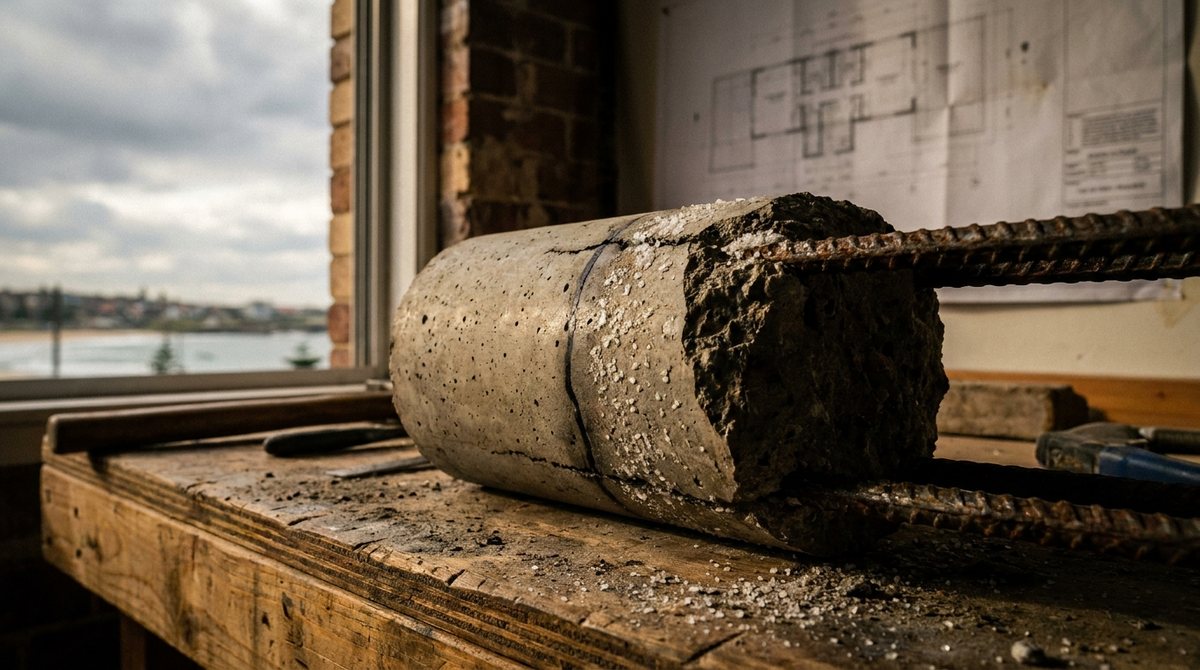
Two buildings, the same visible defect. A Bondi balcony soffit and a Parramatta carpark slab both show rust staining and spalling concrete. The damage looks identical. The cause is not. One is chloride attack, driven by salt. The other is carbonation, driven by atmospheric carbon dioxide. The rectification that holds depends on knowing which one you are looking at.
This is where concrete cancer stops being a single problem and becomes two.
How steel stays protected in the first place
Fresh concrete is highly alkaline, around pH 13. At that alkalinity, a thin passive oxide layer forms on the reinforcing steel and protects it from corrosion. The steel can sit in sound, alkaline concrete for the life of the building without rusting. Concrete cancer is what happens when that protection breaks down. There are two ways it breaks down, and they are chemically different.
Carbonation: the slow atmospheric path
Carbon dioxide in the air reacts with the alkaline compounds in concrete and gradually lowers the pH. The reaction starts at the surface and advances inward as a front. When the carbonation front reaches the depth of the steel, the pH around the bar drops below the level that sustains the passive layer. The protection fails, and the steel begins to corrode in the presence of moisture and oxygen.
Carbonation is slow and even. It advances roughly with the square root of time, so it slows as it goes deeper. It is the dominant cause in sheltered, inland concrete, carparks, internal columns, soffits away from salt air. Where the original cover was thin, as it often was under older AS 3600 specifications, the front reaches the steel decades sooner than it would on a generously covered element. The Parramatta carpark slab is a carbonation story.
Chloride attack: the aggressive coastal path
Chloride ions are a different mechanism. They do not lower the pH of the whole concrete. They penetrate to the steel and break down the passive layer locally, at pin-points. The result is pitting corrosion, deep and concentrated, rather than the broad even corrosion carbonation produces. Chlorides come from salt air, from sea spray, and occasionally from chloride-contaminated materials in the original mix.
Chloride attack is the dominant cause on Sydney's coastal stock. Bondi, Coogee, Maroubra, Bronte, the harbourside foreshore. A balcony forty metres from the surf is taking salt-laden air every day. The chlorides accumulate in the concrete over years until the threshold concentration at the steel is reached, and then the corrosion is fast and aggressive. Critically, chlorides stay in the concrete. Removing the spalled concrete does not remove the chloride that has soaked into the sound concrete around it.
Why the rectification differs
For carbonation, the rectification logic is straightforward. Break out the carbonated, spalled concrete to sound material, treat the steel, reinstate the cover with a polymer-modified mortar, and apply an anti-carbonation coating to slow the front from re-advancing. The new alkaline repair material re-passivates the exposed steel.
For chloride attack, there is a complication. The sound-looking concrete around the repair is often still chloride-laden. Patch it conventionally and you create an incipient-anode effect, where the newly repaired area becomes cathodic and drives accelerated corrosion in the adjacent chloride-contaminated concrete, the so-called ring-anode or halo effect. The repair holds, but a new spall appears right next to it within a year or two. Chloride-driven corrosion is where cathodic protection, sacrificial or galvanic anodes, earns its place, because it interrupts that corrosion cell rather than just patching one node of it.
How the cause gets confirmed
A carbonation depth test (phenolphthalein indicator on a fresh face) shows how far the front has advanced. A chloride content test on drilled dust samples taken at increasing depths shows the chloride profile through the cover. Together they tell you which mechanism is driving the corrosion, and whether both are present. On a coastal building with thin cover, they often are.
What to do next
- On any concrete cancer scope, ask which mechanism was diagnosed, carbonation, chloride, or both, and what test confirmed it.
- On coastal stock, expect chloride to be in play, and expect the scope to address the incipient-anode risk, not just the visible spall.
- Treat a scope that ignores chloride testing on a beachside building as incomplete.
- Ask whether anodes are warranted. On chloride-driven corrosion, they often are.
How Supcon handles this
Thomas runs the carbonation depth test and, on coastal stock, the chloride profile, before the rectification method is set. A carbonation-driven defect gets the break-out, treat, reinstate, coat sequence. A chloride-driven defect gets the method that interrupts the corrosion cell, which on most beachside balconies means anodes designed into the repair.
The cause sets the method. See sacrificial versus galvanic anodes for the cathodic protection detail, and the concrete cancer repair service page for the full method.
Get a remedial scope. Send through the issue.