Sacrificial versus galvanic anodes in concrete repair
On chloride-attacked coastal concrete, a conventional patch can drive the next spall. Galvanic anodes interrupt the corrosion cell. Here's how cathodic protection works in a repair.
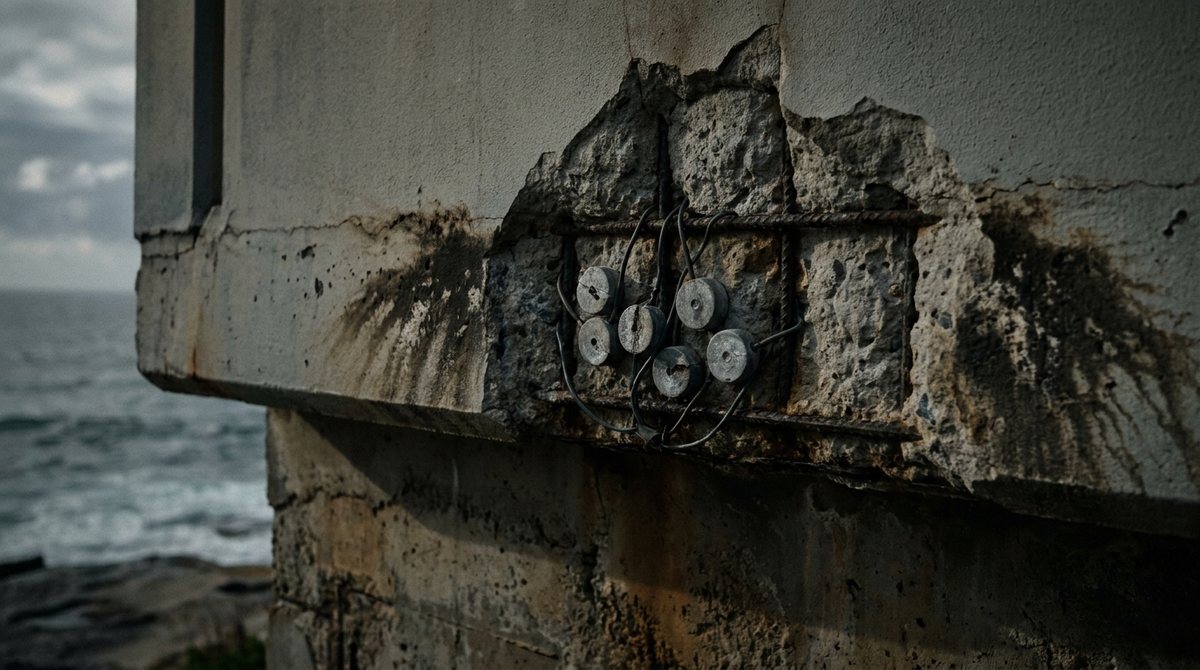
A Bronte balcony soffit gets a textbook concrete cancer patch. Break out, treat the steel, reinstate the cover, coat the surface. Eighteen months later a new spall appears right beside the repair. The patch did not fail. It caused the new spall. On chloride-attacked coastal concrete, a conventional repair can drive corrosion in the sound-looking concrete next to it. Galvanic anodes exist to stop that, and on Sydney's beachside stock they often belong in the scope.
The patch that fixes one spot can start the next. Here is why, and how anodes prevent it.
The incipient-anode problem
When chloride-laden concrete corrodes the steel, it sets up a corrosion cell, anodic areas where the steel is actively corroding and cathodic areas nearby. When you cut out the corroding concrete and replace it with fresh, alkaline repair mortar, you re-passivate the steel in the patch. But the chloride is still in the sound-looking concrete around the patch. The repaired area becomes cathodic relative to the surrounding chloride-contaminated concrete, and that drives new anodic corrosion in the steel just outside the patch.
This is the incipient-anode or ring-anode effect, sometimes called the halo effect. The repair is sound. The new spall it triggers, a ring of fresh corrosion around the patch, is the problem. It is the classic reason a conventional patch on coastal chloride-attacked concrete comes back within a year or two, a metre from where the work was done.
What cathodic protection does
Cathodic protection interrupts the corrosion cell. The principle is electrochemical. By making the reinforcing steel the cathode of a deliberate cell, the corrosion is driven onto a different anode instead of the steel. The steel stops corroding because the corrosion has somewhere else to go. In repair work, the practical form of this is the embedded galvanic anode.
Galvanic anodes: how they work in a patch
A galvanic anode is a lump of a more reactive metal, typically zinc, cast into the repair and tied to the reinforcing steel. Because zinc is more electrochemically active than steel, it preferentially corrodes, the sacrificial part, and in doing so it supplies a protective current to the surrounding steel. The anode is consumed over its service life, slowly, while the steel it protects stays passive.
Placed around the perimeter of a chloride repair, galvanic anodes counter the incipient-anode effect directly. Instead of the patch driving corrosion into the adjacent chloride-laden concrete, the anodes feed protective current into that steel and keep it passive. The ring of fresh spalls that a conventional patch would have triggered does not form. This is sometimes called sacrificial cathodic protection, because the anode sacrifices itself to protect the steel. It needs no external power, the galvanic cell drives itself.
When anodes belong, and when they do not
Anodes earn their place where chloride is the driver, coastal balconies, soffits, and slabs taking salt air, where the sound concrete around any repair is still chloride-laden. On those buildings, a patch without anodes is a patch that schedules its own ring of follow-up spalls.
Where the corrosion is carbonation-driven and inland, away from salt, anodes are usually not needed. Carbonation does not leave the surrounding concrete aggressive in the same way, so the re-passivation from the repair mortar is enough, paired with an anti-carbonation coating to slow the front. This is why the cause diagnosis, chloride versus carbonation, sets the method. The same visible spall gets a different repair depending on what is driving it.
What to do next
- On any coastal concrete cancer scope, ask whether the incipient-anode risk was assessed and whether galvanic anodes are specified.
- Treat a conventional patch on a beachside building, with no chloride testing and no anodes, as a repair that schedules its own follow-up.
- Confirm the cause was diagnosed as chloride or carbonation before the method was set. The cause decides whether anodes belong.
- Ask about the anode service life so the OC understands the protection horizon.
How Supcon handles this
On coastal stock, Thomas tests the chloride profile and assesses the incipient-anode risk before the repair method is set. Where chloride is the driver, galvanic anodes are designed into the repair perimeter to interrupt the corrosion cell, so the patch protects the surrounding steel rather than driving new spalls into it. Inland carbonation-driven defects get the re-passivation and anti-carbonation coating method instead.
The cause sets the method, and on the coast the method usually includes anodes. See chloride attack versus carbonation for the cause diagnosis, and the concrete cancer repair service page for the full method.
Get a remedial scope. Send through the issue.