Chemical DPC chemistry: how rising damp is actually stopped
A chemical damp proof course stops capillary rise in an old terrace wall. The chemistry is a water-repellent injected into the mortar course. Here's how it forms the barrier.
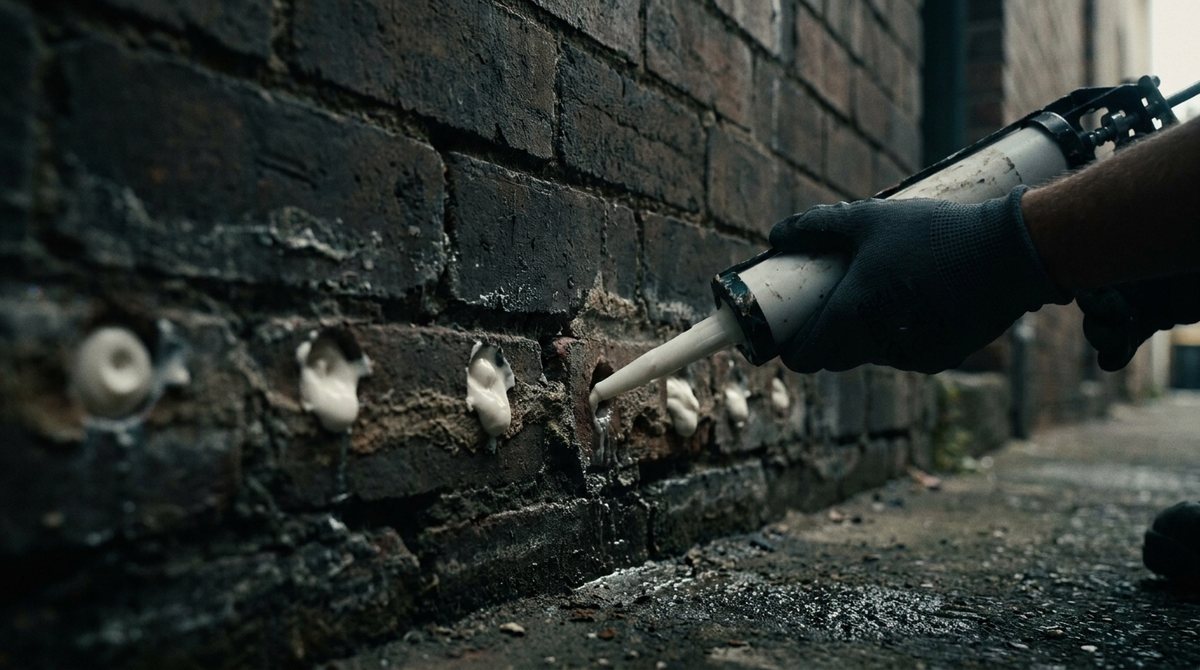
A chemical damp proof course is the standard fix for rising damp in an old Newtown terrace, but the phrase makes it sound like a mystery. It is not. It is a water-repellent chemistry injected into a mortar course, where it lines the pores of the brick and mortar so capillary water can no longer climb. Understanding the chemistry is the difference between trusting the fix and treating it as a black box the contractor sells.
Rising damp is capillary action. A chemical DPC defeats the capillary action at the molecular level.
Why the water rises in the first place
Brick and mortar are porous, threaded with tiny interconnected capillaries. Water in the ground is drawn up these capillaries by surface tension, the same way water climbs up a paper towel dipped at one edge. The narrower the pore, the higher the water climbs. In a wall with no working damp proof course, the water rises until evaporation at the wall surface balances the rate of climb, typically 300mm to 600mm up the wall, sometimes higher.
An original damp proof course, slate, bitumen, or lead in old Sydney terraces, was a physical barrier built into the wall to block this rise. When it cracks, degrades, or gets bridged by later render or paving, the barrier fails and the water climbs again. A chemical DPC restores the barrier without rebuilding the wall.
What the chemistry does
The injected material is a water-repellent, typically a silane, a siloxane, or a blend, delivered as a low-viscosity liquid or a cream. Once in the mortar course, it does two things. It penetrates the pore network and reacts with the moisture and the silica in the masonry to bond a water-repellent lining onto the pore walls. That lining does not block the pores, it lines them, changing their surface chemistry so water no longer wets them.
The effect is to reverse the surface tension that drives capillary rise. A normal pore wall is hydrophilic, water-loving, so water climbs it. A treated pore wall is hydrophobic, water-repelling, so water beads and is pushed back rather than drawn up. The capillary action that lifted the water is not just blocked, it is reversed. The treated band becomes a horizontal water-repellent barrier across the full thickness of the wall, and the water below it can no longer climb past.
Cream versus fluid, and why it matters
The older method injected a low-viscosity fluid under pressure or by gravity into drilled holes along the mortar course. It works, but the dosage is hard to control in a wall of variable porosity, the fluid runs to the easy paths and can under-treat the dense sections.
The modern method injects a high-concentration cream into the drilled holes. The cream stays put at the injection point and diffuses laterally along the mortar course as it reacts, giving a more even, controllable dose across the wall thickness. For a rubble-filled or variable old terrace wall, the cream's controllability is a real advantage, and it is the common choice in current remedial practice. Either way, the holes are drilled along the chosen mortar course at the spacing the manufacturer specifies for the wall thickness, typically 90mm to 120mm centres, so the treated zones overlap into a continuous barrier.
Why the wall does not dry overnight
Installing the DPC stops new water rising. It does not instantly dry the water already in the wall above it. That residual moisture, and the salts it carried up over decades, evaporates out over the following six to twelve months. This is why the salt-laden plaster has to come off and salt-resistant render has to go back, and why the wall is left to dry before final finishes. The chemistry stops the source. The drying is the wall recovering from what the source did before it was stopped.
What to do next
- On any rising damp scope, confirm the DPC is a recognised silane or siloxane system, injected to the manufacturer's spec for the wall thickness.
- Expect cream injection on a variable old terrace wall for dose control across the thickness.
- Confirm the scope removes the salt-laden plaster and reinstates salt-resistant render, not just the DPC alone.
- Plan for the six to twelve month dry-out. The DPC stops the rise immediately, but the wall recovers gradually.
How Supcon handles this
Thomas selects the DPC system to the wall, injects a silane or siloxane cream into the mortar course at the specified centres so the treated zones overlap into a continuous barrier, then removes the salt-laden plaster and reinstates salt-resistant render. The wall is left to dry before final finishes go on.
The chemistry stops the capillary rise. The render and the dry-out let the wall recover. See rising damp in inner west terraces for the full sequence, and the rising damp and damp proof course service page for the technical detail.
Get a remedial scope. Send through the issue.