Concrete cancer in Sydney apartment buildings: what you're actually seeing
Brown stains on the soffit. Render bubbling at the parapet. Rebar showing through the cover. A plain-English guide to concrete cancer in Sydney's 2000-2020 strata buildings.
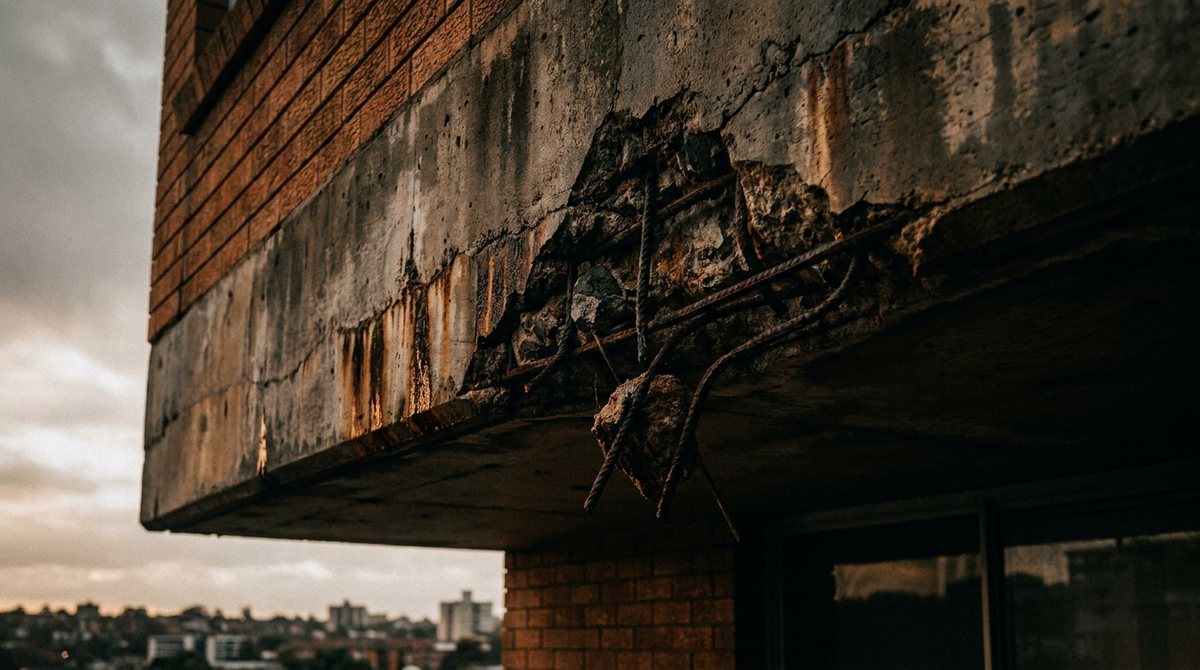
Brown rust stains running down the soffit of a 2008 strata block in Hurstville. Render bubbling away from the parapet of a Bondi mid-rise built in 2011. A chunk of soffit on the carpark floor of a Mascot building that was not there last week. These are not cosmetic issues. They are concrete cancer in three different stages, in three buildings, all caught up in the same generational defect wave.
Sydney's 2000 to 2020 strata building stock is failing on the same timeline.
What concrete cancer actually is
The technical term is reinforcement corrosion causing concrete spalling. Concrete is porous. Over time, water and chloride ions migrate through the concrete cover and reach the reinforcing steel inside the slab, the balcony soffit, the parapet, or the facade panel. The steel oxidises. Rust forms. Rust takes up roughly seven times the volume of the original steel.
That expansion blows the concrete cover apart from the inside. By the time you see the stain on the outside, the steel has been corroding for months or years and the structural integrity of that element is already compromised. This is electrochemical. It does not stop because you painted over the stain. It does not slow because you scraped back the loose render and recoated. It keeps going until the source of the water is fixed and the affected steel and concrete are properly rectified.
Why Sydney's 2000-2020 building stock is failing now
Three pressures hit at the same time.
Older AS 3600 concrete cover specifications were thinner than current. Faster builds during the apartment boom meant value-engineered membrane systems and less time spent detailing every junction. Twenty years of UV, salt air (especially in eastern suburbs and on the north shore foreshore), thermal cycling, and moisture have caught up with thousands of buildings at once.
Hurstville, Mascot, Wolli Creek, Rhodes, Olympic Park, parts of Parramatta. Big mid-rise build runs from 2005 to 2012. The membranes on balconies and planter boxes installed in those builds are at end of life. Once the membrane fails, water reaches the slab steel. Once the slab steel rusts, the concrete spalls. Once the concrete spalls, you can see it from the street.
Where it shows up first
Balcony soffits are the most common. The membrane fails, water tracks through the slab, and the underside of the balcony develops drummy patches that progress to visible spalling. Walk under a row of balconies on a 2008 mid-rise and look up. Rust staining or render bubbling is the start.
Parapets are next. The capping fails, water enters the top of the wall, the steel inside corrodes, the render breaks down. Common pattern on Bondi and Coogee mid-rise where salt air accelerates the chemistry.
Carpark slabs under landscaped podium decks. Planter box membranes fail, water tracks through the slab, the carpark soffit develops the same spalling pattern. Carparks are usually where the strata manager first sees the chunk of concrete on the floor. Facade render is the fourth. Render cracks at slab edges, water enters the wall behind, the wall ties corrode, the render delaminates, the steel inside the panels starts showing through.
What a proper rectification looks like
Diagnose the source. The water has to be entering somewhere. Failed membrane, broken parapet capping, render crack, planter box leak above. The rectification cannot end until the source is fixed.
Map the extent. Hammer-tap the affected area. Every drummy patch gets recorded. Cover-meter survey for steel depth and condition. The scope captures what is visible plus what the survey reveals.
Break out the compromised concrete to expose sound steel. Treat the steel back to bare metal, apply corrosion-inhibiting primer, and where section loss exceeds tolerance (typically a 10 percent reduction in bar diameter, scoped per engineer's call), lap in additional bar. Reinstate the cover with a polymer-modified repair mortar built up in layers per the manufacturer's spec, finished to match the surrounding profile.
Fix the source at the same time. Membrane replacement to AS 4654.2, parapet capping reinstated, drainage corrected. There is no point rectifying the concrete if the water can reach the steel again next month. Finish with an anti-carbonation protective coating, which buys decades on the rectified element.
What to do next
- If you are seeing rust staining on render, soffits, or balcony undersides, get a hammer-tap survey across the full elevation. The visible spalling is usually a fraction of the actual extent.
- Get a scope that names the source, the extent, the rectification method, the materials specified to AS 3600 and AS 4654.2, and the protective coating. A scope without those elements is a surface job in disguise.
- Brief your building consultant if the OC needs a second technical opinion before approving.
- Understand the progression. Concrete cancer caught in the first year of visibility is a far smaller scope than the same defect left to spread to the reinforcement across an elevation.
How Supcon handles this
Thomas walks the building, runs the hammer-tap survey, identifies the source, and writes the scope of works against the actual defect map. The scope covers the rectification to AS 3600, the source-fix to AS 4654.2, and the protective coating. Variations only happen in writing.
The work is done once. Five years on, the rectified element is still rectified. See chloride attack versus carbonation for the chemistry that decides the method, and the concrete cancer repair service page for the technical detail behind the work.
Get a remedial scope. Send through the issue.