Hills district newer stock and its early defects
The Hills district built a wave of apartments in the 2010s around the metro. That stock is recent enough that its first defects are membrane and detailing issues. Here's the profile.
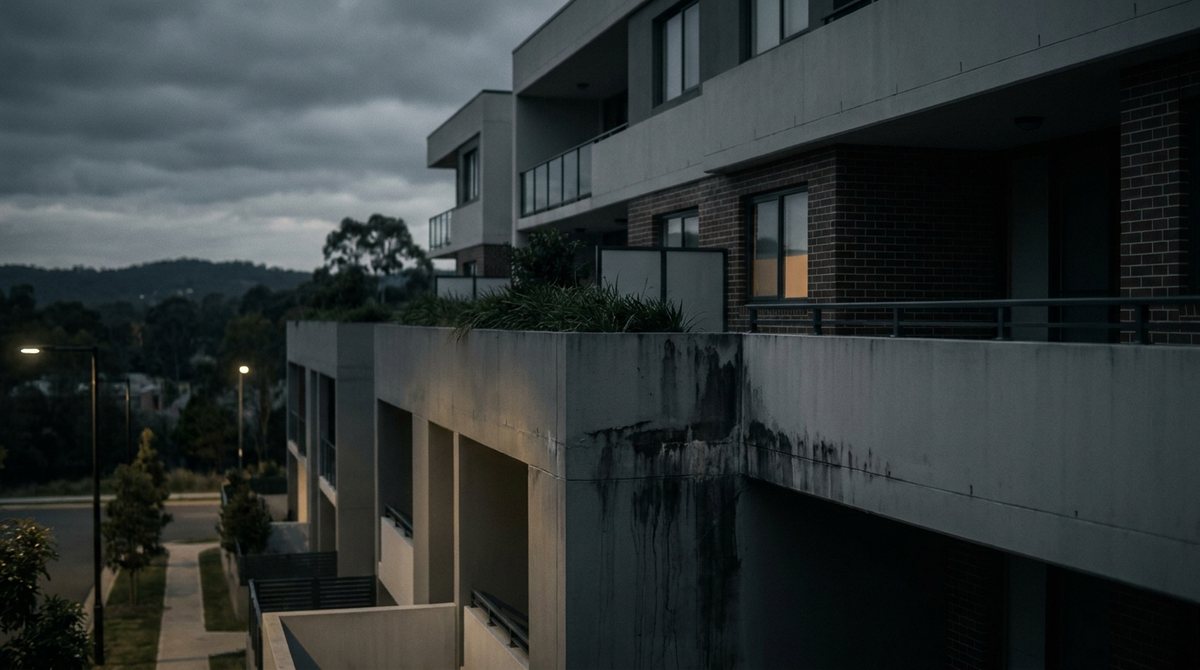
The Hills district transformed in the 2010s. The North West Metro brought a wave of apartment development to Castle Hill, Kellyville, Rouse Hill, Bella Vista, and Norwest, much of it built in the back half of the decade. That stock is now reaching the age where its earliest defects appear, and because it is recent construction, the profile is dominated by membrane and detailing issues rather than the structural progression of older buildings. The Hills stock is at the front of its defect timeline.
The Hills apartment stock is recent enough that its defects are first-stage, membrane and detailing, not structural.
Why the Hills built so much, so recently
The Hills district was, until the 2010s, predominantly a low-density area of detached housing. The North West Metro and the rezoning around its stations triggered a concentrated apartment-building boom, much of it from around 2015 onward, around the new station precincts and the Norwest business park. The result is a large body of apartment stock that is, in building-defect terms, recent.
Because so much of it went up in the same compressed period, the Hills stock will move through its defect timeline together, the same way the 2005 to 2012 stock of the inner suburbs did. The buildings that completed around 2015 to 2018 are now reaching the age where the first membrane and detailing defects surface.
Why the defects are first-stage
Recent stock has not had time to progress to the structural stage. The reinforcement corrosion, the spalling concrete, the facade fatigue, those are consequences of years of unaddressed water ingress, and the Hills stock has not been standing long enough for that progression to advance far. What it does have is the first-stage defects, the membrane failures and detailing issues that appear in the first decade of a building's life.
These are the threshold upstands that were set marginal, the balcony falls that pond, the podium and planter membranes beginning to fail at their perimeters, the wet-area membranes failing into the unit below, the sealant joints that were under-specified. The same boom-era pressures, volume, speed, value-engineered detailing, that shaped the inner-suburb stock shaped the Hills stock too. The defects are just earlier in their progression.
Why catching it early matters most here
The Hills stock is at the single most valuable point to intervene, the membrane stage, before the water has reached the reinforcement. A Castle Hill building that addresses its threshold and podium membrane failures now, to AS 4654.2, with the marginal falls and upstands corrected, never enters the structural stage. The whole structural-progression argument is most powerful here, because the progression has barely begun and stopping it is still a waterproofing job.
The risk is that recent buildings get treated as too new to have real problems, and the first leaks get surface-repaired or dismissed. That lets the progression start. A committee on Hills stock that treats the first membrane failures as the leading edge of the building's defect timeline, and addresses them properly, keeps the building out of the structural stage entirely.
What to do next
- On Hills stock from the 2010s, expect first-stage defects, membrane and detailing, and check the balcony thresholds and podium perimeters first.
- Do not dismiss the first leaks as a new building settling. They are the start of the defect timeline.
- Get the falls and upstands assessed against AS 4654.2. Marginal boom-era detailing is the usual root cause.
- Act at the membrane stage. On recent stock this is the highest-value point to intervene.
How Supcon handles this
Thomas assesses Hills stock for its first-stage defects, threshold upstands, balcony falls, podium and planter perimeters, wet-area membranes, against AS 4654.2 and AS 3740, and corrects the marginal detailing as part of the rectification so the new membrane is not relaid on the original mistake. Caught at this stage, the building never has to reach the structural one.
Recent stock is at the cheapest point of its defect timeline to fix. See 2010 to 2020 mid-rise membrane failures for the wider pattern, and the waterproofing and membrane service page for the technical detail.
Get a remedial scope. Send through the issue.