How a cover meter finds reinforcement depth before you break out
Before a concrete cancer scope is written, a cover meter maps where the steel sits and how deep the cover runs. Here's how the survey works and why it changes the scope.
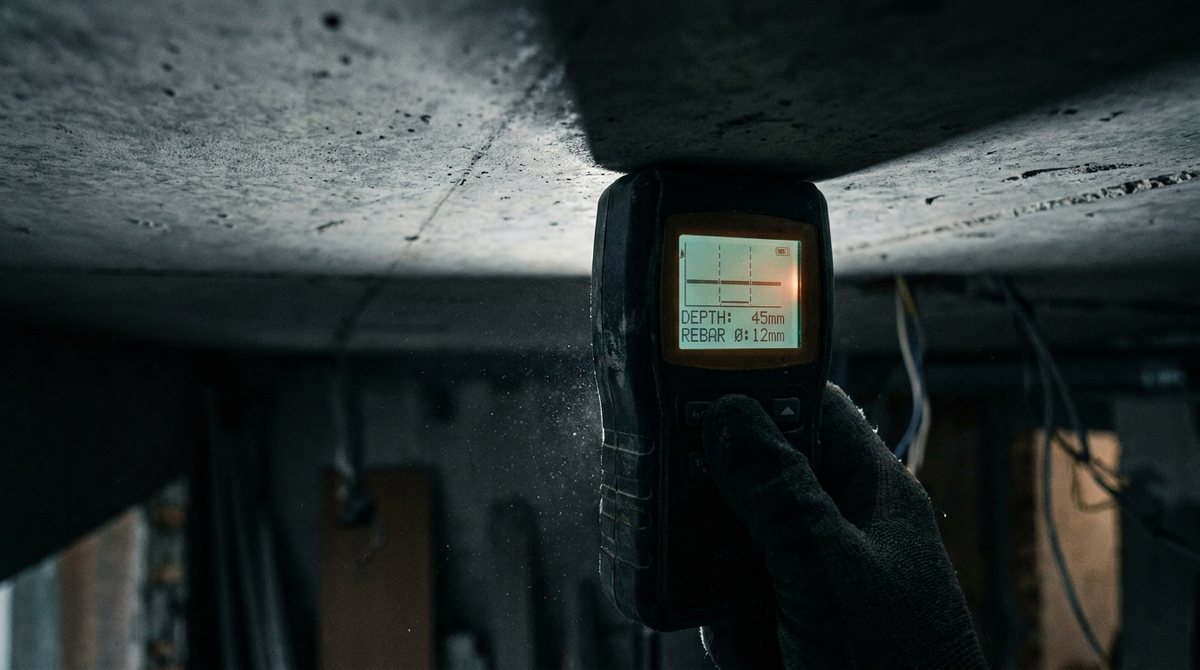
A 2009 Rhodes balcony soffit is spalling at one corner. The visible damage is the size of a dinner plate. The question that decides the scope is not how big the hole is. It is how deep the steel sits across the rest of the soffit, and where the cover has dropped below the line at which carbonation reaches the bar. A cover meter answers that before a single hammer comes out.
Diagnosis precedes break-out. The cover meter is how the diagnosis gets quantified.
What a cover meter measures
A cover meter is an electromagnetic instrument run across a concrete surface. It detects the reinforcing steel beneath and reports two things, the depth of concrete cover over the bar, and the position of the bar. The operator runs it in a grid across the element and builds a map of where the steel sits and how much concrete protects it.
Cover is the single most important number in a concrete cancer diagnosis. AS 3600 specifies minimum cover for a reason. The concrete over the steel is the barrier that slows water, chloride, and carbonation from reaching the bar. Where the cover is generous, the steel stays passivated for decades. Where the cover is thin, the protective barrier is short, and the carbonation front reaches the steel years sooner.
Why the survey changes the scope
Without a cover survey, a contractor scopes what they can see. The dinner-plate spall gets a patch. But the spall is a symptom of a cover problem that almost never stops at the visible edge. A cover meter run across the full soffit routinely finds that the cover drops below tolerance across a third of the element, not just at the corner that failed first.
That is the difference between a patch that fails in two years and a rectification scoped to the actual extent. The areas with low cover and an advanced carbonation front are the areas that spall next. A survey that maps them lets the scope treat the whole at-risk zone in one program, rather than chasing each spall around the building as it surfaces.
Cover meter, then carbonation depth, then break-out
The sequence on a proper concrete cancer diagnosis runs in order. Cover meter survey first, to map the steel and the cover across the element. Then a carbonation depth test, usually a phenolphthalein indicator on a freshly broken or cored face, which shows how far the carbonation front has advanced into the concrete. The two readings together tell you where the carbonation front has already reached the steel and where it is close.
Only then does break-out begin, and it begins at the points the survey identified, not just the visible spall. This is why a scope built on a cover survey looks larger than a scope built on a visual. It is treating the defect the survey found, not the symptom the eye saw.
What this means for a strata committee
When a concrete cancer scope lands on the agenda, the cover survey is the evidence behind the extent. A scope that treats a wider area than the visible damage is not padding. It is responding to a measured cover deficiency across the element. Ask for the survey. Ask where the cover dropped below tolerance. The map is the justification for the scope boundary.
What to do next
- On any concrete cancer scope, ask for the cover meter survey results, not just photos of the visible spall.
- Ask for the carbonation depth reading alongside the cover map. The two together set the rectification boundary.
- Treat a scope that matches the survey extent as the responsible one. The patch that matches only the visible damage is the one that comes back.
- Hand the survey to the building consultant if the OC wants the extent independently confirmed.
How Supcon handles this
Thomas runs the cover meter across the full element, takes the carbonation depth reading, and writes the scope to the survey, not the symptom. The break-out happens where the map says the cover and the carbonation front have compromised the steel. The rectification reinstates the cover to AS 3600 and the source-fix to AS 4654.2.
The survey is the reason the scope boundary is where it is. See concrete cancer in Sydney apartment buildings for the full defect picture, and the concrete cancer repair service page for the technical detail.
Get a remedial scope. Send through the issue.