How moisture mapping locates the true leak source
A stain in a Mosman bedroom ceiling rarely sits under the actual leak. Moisture mapping traces the water back to where it enters. Here's how the survey finds the source.
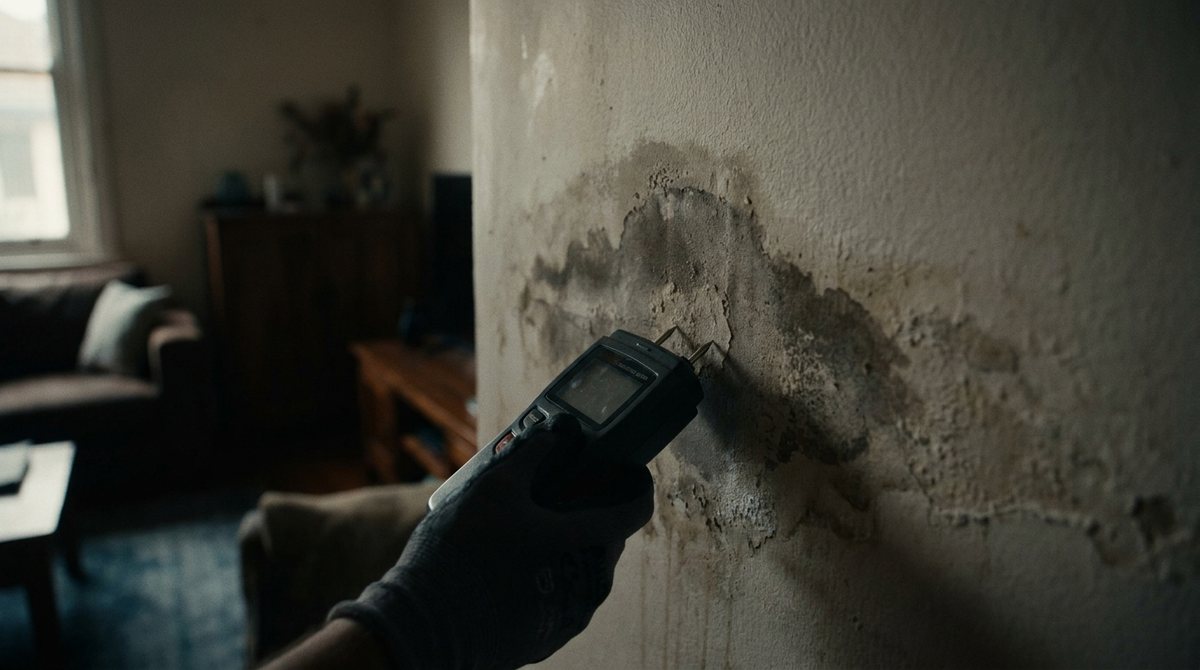
A Mosman apartment has a brown stain in the bedroom ceiling, hard against the external wall. The owner is certain the leak is directly above. It almost never is. Water enters at one point, tracks along a slab, a beam, or a service penetration, and surfaces wherever gravity and the path of least resistance let it. Fix the spot above the stain and the stain comes back, because the entry point was three metres away. Moisture mapping is how the real source gets found.
Water travels. The stain is where it stopped, not where it started.
Why the visible stain misleads
A concrete slab is not a simple surface. Water that breaches a membrane or a sealant joint enters the build-up, then moves laterally along the path of least resistance, screed lines, slab falls, service conduits, construction joints, until it finds a low point or a crack to weep through. The distance between entry and exit can be small or it can run the length of a balcony.
This is why surface repairs aimed at the stain fail so reliably. The repair seals a spot where the water exits. The water simply backs up and finds the next exit. The committee sees a fresh patch of ceiling for a few months, then the stain returns a metre to the left.
What moisture mapping actually does
Moisture mapping is a structured survey of moisture content across a surface or an element. The tools are non-destructive to begin with. A capacitance or resistance moisture meter reads relative moisture across a grid. A thermal imaging camera shows temperature differences, because evaporating moisture cools a surface, so a wet zone reads cooler than a dry one. The two together build a picture of where the moisture concentrates.
The survey works backward from the stain. It maps the wet zone on the ceiling, then maps the corresponding area above, the balcony deck, the planter, the facade behind the wall, and traces the moisture gradient toward its highest concentration. The wettest point is usually at or near the entry. From there the diagnosis can confirm with a targeted tile lift or a sealant cut at the suspected entry, rather than opening the whole deck blind.
Reading a moisture gradient
Moisture content rises as the survey approaches the source. A reading taken across a balcony deck might show low moisture at the outer edge, climbing toward the hob upstand at the building face. That gradient points to the hob as the entry. A reading that climbs toward the drain points to a failed drainage detail. A reading that climbs toward a planter wall points to the planter membrane. The gradient is the arrow back to the source.
Without the gradient, the diagnosis is a guess, and a guess on a remedial job is the difference between a fix and a repeat call. The map removes the guess.
Where moisture mapping changes the scope
On a building with multiple stains, moisture mapping often reveals that several apparently separate leaks share one source. Three stained ceilings on three floors can all trace to one failed planter membrane at the top, the water tracking down the same column line. Scoping each stain separately would mean three surface repairs and three return visits. The map shows the single source, and the scope addresses it once.
What to do next
- On any persistent leak, ask whether a moisture map was done before the scope was written. A scope aimed at the stain is aimed at the wrong place.
- Ask for the moisture gradient, where the readings climbed, and what that pointed to as the entry.
- On a building with multiple stains, ask whether they share a source before approving multiple separate repairs.
- Treat thermal imaging and meter readings as the evidence behind the diagnosis, not optional extras.
How Supcon handles this
Thomas maps the moisture from the stain backward, with a meter and thermal imaging, before the scope is written. The wettest point identifies the entry. A targeted tile lift or sealant cut confirms it. The scope then addresses the actual source, and on multi-stain buildings, the single source feeding several of them.
The map is why the source-fix holds. See why the source-fix outlasts the patch for the progression behind addressing the source, and the waterproofing and membrane service page for the technical detail.
Get a remedial scope. Send through the issue.