The remedial realities of inner west terraces
Inner west terraces in Newtown, Glebe, and Annandale share a remedial profile, damp, old brick, heritage detail. Here's what a century-old terrace actually needs from a remedial scope.
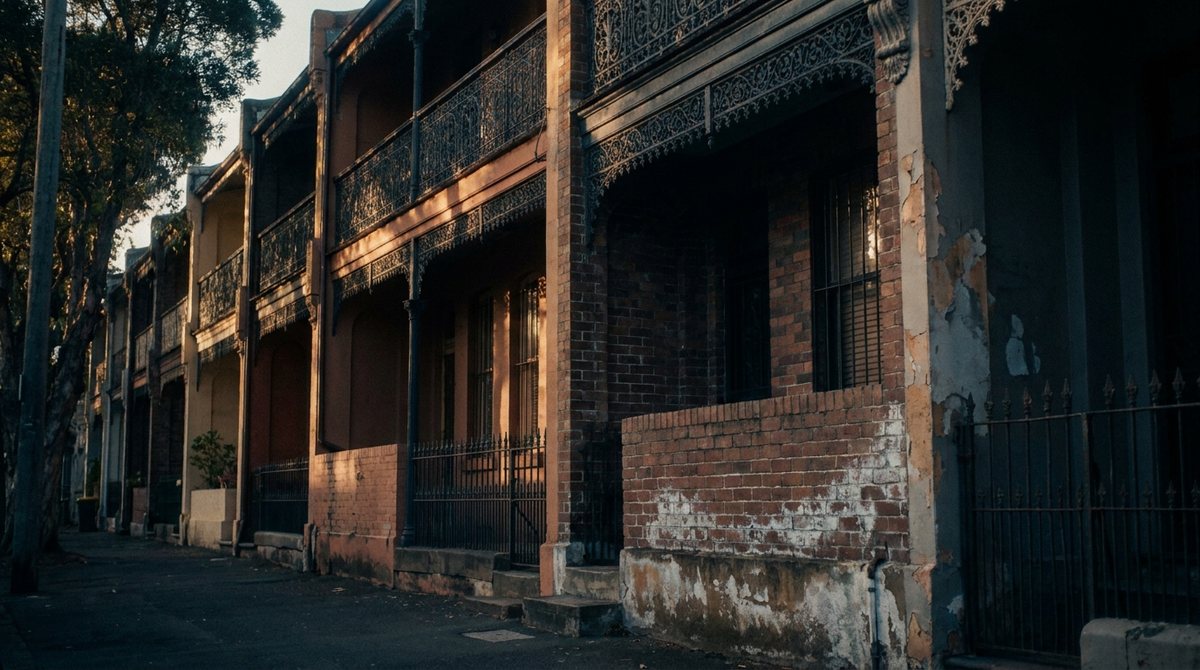
A Newtown terrace, a Glebe terrace, and an Annandale terrace, all built between the 1880s and the 1910s, share a remedial profile that is nothing like a modern apartment's. Soft old brick, no working damp proof course, lime mortar, heritage detail worth preserving, and a century of renovations layered on top, some sympathetic, some not. The inner west terrace is one of Sydney's most distinctive remedial challenges, and treating it like a modern building gets it wrong on almost every front.
A century-old terrace is a different kind of building. The remedial approach has to respect what it is made of.
What the inner west terrace is made of
The classic inner west terrace is solid masonry, load-bearing brick walls laid in soft lime-based mortar, with timber floors and roof structure, often a rendered or face-brick front, and frequently no damp proof course or one that has long since failed. The materials are soft and breathable by modern standards, and the building was designed to move and let moisture pass through and evaporate.
A century on, these terraces have been renovated repeatedly. Bathrooms added, kitchens extended, rear additions built, walls rendered, paths and paving laid. Each layer of renovation interacts with the original fabric, and many of them, cement render over soft brick, paving built up above the damp course, sealed modern finishes on breathing walls, have created or worsened the defects a remedial scope now has to address.
Reality 1: rising damp is almost universal
Most inner west terraces have a rising damp problem, because most were built without a working damp proof course, or had the original course bridged by later work. The dark band at the base of the walls, the salt bloom, the perished skirtings, the blistering paint, it is the near-universal inner west complaint. The fix is a chemical damp proof course, the salt-laden plaster removed and salt-resistant render reinstated, and the bridges, raised paving, rendered-over courses, addressed.
What makes it a terrace-specific challenge is the heritage fabric and the party walls. The shared walls with the neighbours, the original plaster and cornices, the tessellated tiles and fireplaces, all constrain how the work is done. A rising damp rectification on a terrace is as much about working sympathetically around what is worth keeping as it is about the damp course itself.
Reality 2: the render and brick must be matched
The soft old brick and lime mortar of a terrace will not tolerate a hard modern cement render. The compatibility rule, render no stronger than the substrate, vapour-permeable so the wall breathes, governs every render decision on a terrace. Hard cement render and sealed modern coatings trap moisture, accelerate the damp, and delaminate, taking the brick face with them.
A remedial render scope on a terrace specifies lime-based or breathable systems matched to the brick, and treats the substrate properly first. This is the opposite of the approach a modern building takes, and a contractor who renders a terrace the way they would render a new wall does lasting harm to the fabric.
Reality 3: heritage detail constrains everything
Many inner west terraces sit in heritage conservation areas, and many retain original detail, lacework, parapets, chimneys, joinery, tessellated verandah tiles, worth preserving for the building's character and its value. A remedial scope on a terrace has to work around and protect this detail, and where the heritage controls apply, the work may need to use sympathetic materials and methods and respect the conservation requirements.
This is where remedial work on a terrace becomes as much craft as construction. The damp has to be stopped, the render reinstated, the structure made sound, all without damaging the heritage fabric that makes the terrace what it is. It is detailed, careful, sympathetic work, not a fast modern rectification.
What to do next
- Treat a terrace as a soft, breathing, heritage building, not a modern one. The materials and methods are different.
- Expect rising damp to be present, and expect the fix to work sympathetically around heritage fabric and party walls.
- Insist on render matched to the old brick, lime-based or breathable, never hard cement on soft brick.
- Confirm the scope respects any heritage conservation controls and protects the original detail.
How Supcon handles this
Thomas approaches a terrace as the soft, breathing, heritage building it is. Rising damp gets a chemical damp proof course with the salt-laden plaster removed and breathable render reinstated, worked sympathetically around the original fabric. Render is matched to the old brick. The heritage detail is protected, and any conservation controls are respected in the method.
The terrace rewards a remedial approach matched to its century, not a modern template. See Federation and Victorian terrace damp for the damp detail, and the rising damp and damp proof course service page for the technical detail.
Get a remedial scope. Send through the issue.