Federation and Victorian terrace damp in the inner west
Glebe, Balmain, Leichhardt, Annandale. Why pre-1920 terraces hold damp the way they do, and what a century-old wall actually needs from a remedial scope.
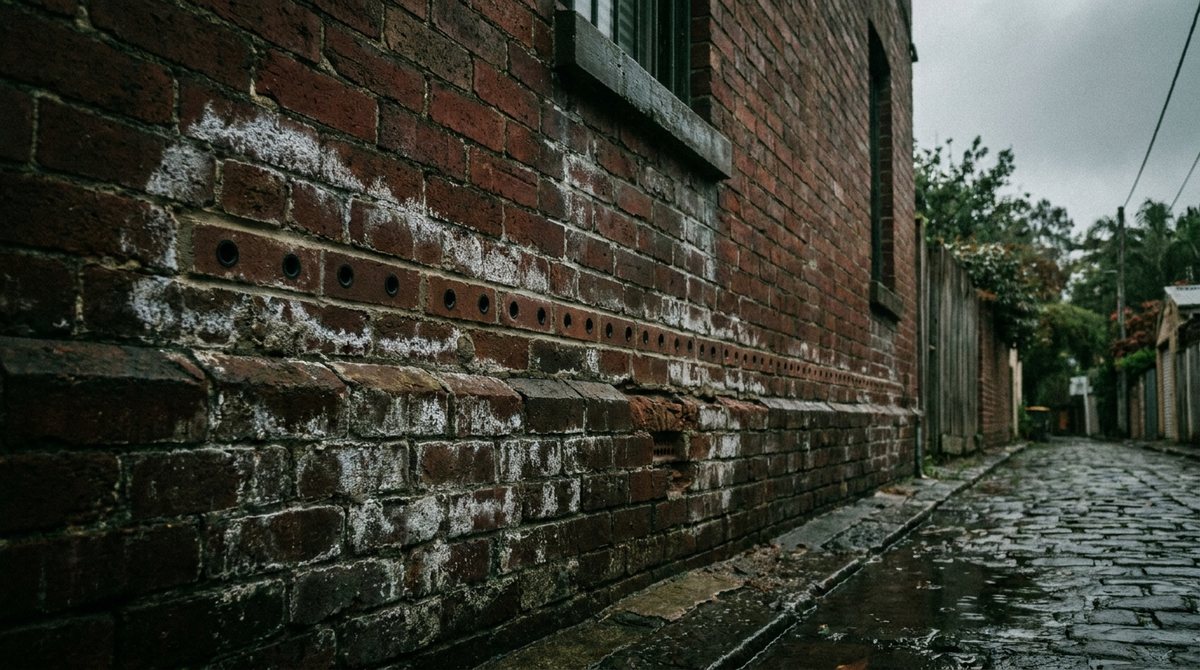
A Glebe terrace built in 1898 holds damp differently from a unit built in 2008, and the reason is in the wall itself. Solid double-brick, lime mortar, a slate or bitumen damp proof course that was state of the art when Federation arrived and has been cracked for sixty years. The inner west is full of this stock. Balmain, Leichhardt, Annandale, Newtown, Erskineville. Read a century-old wall with a modern template and the scope fails it.
The terrace is not a defective modern building. It is a sound old one that needs to be understood on its own terms.
Why the original DPC has usually failed
Victorian and Federation terraces were built with a physical damp proof course, a layer of slate, engaging brick, or bitumen laid in the wall a few courses above ground. It was a genuine engineering answer to rising damp, and when intact it works. The problem is age. A slate course cracks as the building settles over a century. A bitumen course goes brittle and fails. Most pre-1920 stock either never had a course that survived or has one that broke decades ago.
On top of that, a century of renovations bridges whatever course remains. A later cement render carried down past the DPC line gives the water a path around it. A raised garden bed, a new concrete path, a tiled courtyard built up against the wall above the course, every one of these bridges the original DPC and lets the damp climb past it. So the terrace that was dry for ninety years starts showing a dark band and a salty bloom, and the cause is rarely a single thing.
Why solid brick behaves differently
A modern cavity wall has an air gap that interrupts moisture movement, the kind of detailing AS 3700 governs in masonry built today. A Victorian solid double-brick wall has no cavity. The two skins of brick are bonded solid, and water moves through the whole thickness by capillary action. Lime mortar, softer and more porous than modern cement mortar, carries moisture readily.
This is why a terrace wall wicks damp so thoroughly, and why the wrong repair does so much harm. A hard, non-breathable cement render or a modern impervious paint traps the moisture the porous wall is trying to release. The water has nowhere to evaporate, so it climbs higher, migrates sideways, and accelerates the breakdown of the lime mortar and plaster behind the coating. The terrace needs to breathe. A century of design assumed it would.
What a century-old wall actually needs
The scope on a Federation or Victorian terrace starts by confirming the mechanism. A moisture meter reading at several heights, a look at the external wall for the DPC line and any bridge, a salt analysis where the bloom is heavy. The reading separates rising damp from penetrating damp or a plumbing leak, because the fix is different for each.
Where it is rising damp, the work is a chemical damp proof course installed to the manufacturer's specification, any bridge to the original course removed or lowered, the salt-laden plaster stripped back to brick, and a salt-resistant, breathable render system reinstated after the wall has dried. The drying period is not optional. A century-old solid wall holds a lot of moisture, and final finishes go on after it has released, not before. Breathable materials throughout, because the wall was built to breathe and it still needs to.
What to do next
- On a pre-1920 terrace, expect the original DPC to have failed or been bridged, and have the external wall checked for both before scoping.
- Refuse hard cement render and impervious paint on a solid-brick terrace wall. The wall needs to breathe or the damp climbs higher.
- Insist on a moisture reading to separate rising damp from penetrating damp or a plumbing leak. The fix differs for each.
- Plan around the drying period. A century-old solid wall needs weeks to release moisture before final finishes go on.
How Supcon handles this
Thomas Pencarinha walks the terrace, reads moisture at three or four heights, inspects the external wall for the DPC line and bridge points, and writes the scope to what the readings show. Chemical DPC to manufacturer's spec, bridges removed, salt-laden plaster stripped, salt-resistant breathable render reinstated after the drying period, finishes after that. The materials are chosen to let a century-old wall do what it was built to do.
A Federation wall rewards a remedial approach matched to its century, not a modern template. See rising damp in inner west terraces for the full pattern, and chemical DPC chemistry for how the injection works. The rising damp and damp proof course service page carries the technical detail.
Get a remedial scope. Send through the issue.