Sutherland Shire coastal exposure and apartment defects
Cronulla and the Sutherland Shire beaches put apartment buildings in a high-salt environment. Here's how coastal exposure shapes the defect profile of shire strata stock, and what it needs.
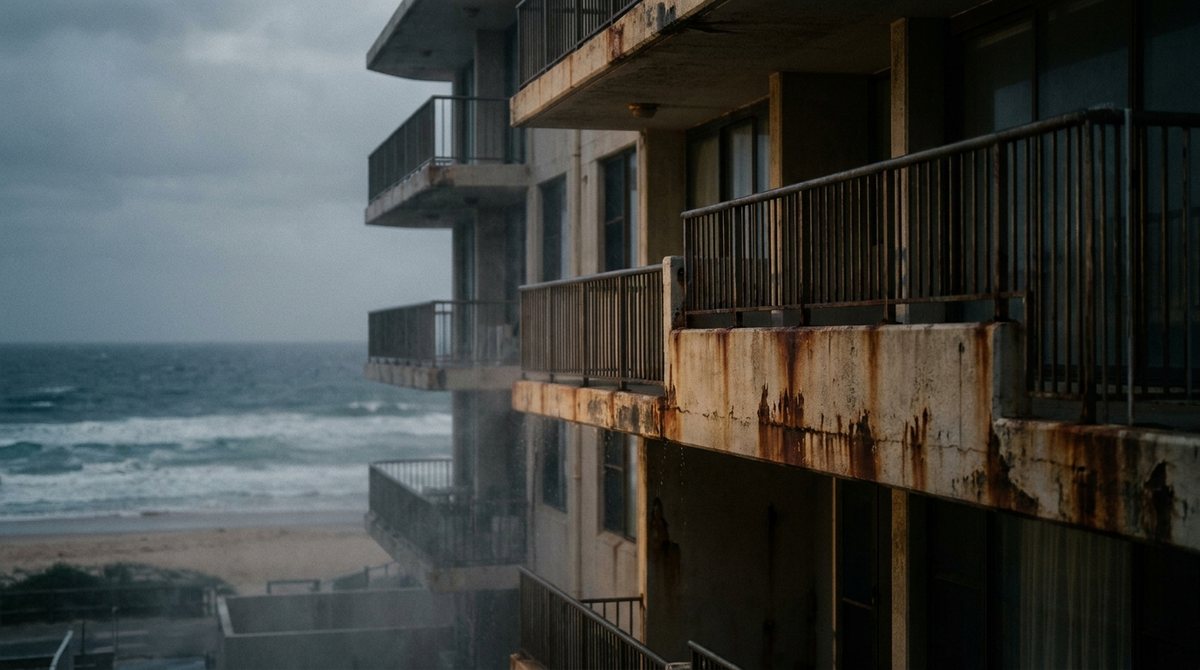
Cronulla puts apartment buildings about as close to open surf as Sydney strata gets. The Sutherland Shire beachfront, Cronulla, Woolooware, the Bate Bay edge, sits in a high-salt coastal environment that works on concrete relentlessly. The defect profile of shire beachfront stock is dominated by salt, and a building a block from the surf in Cronulla has a corrosion clock running faster than almost anywhere else in the city.
On the shire beachfront, salt is the defining force. The defect profile starts and ends with chloride.
Why the shire beachfront is a high-corrosion environment
Cronulla and the Bate Bay beaches face open ocean surf, and the salt aerosol generated by breaking waves is carried inland on the prevailing wind. Buildings within the salt-spray zone, the beachfront and the streets immediately behind, are coated in chloride-laden air continuously. The closer to the surf and the more exposed the aspect, the heavier the salt loading.
This is the same mechanism that drives corrosion on the eastern beaches, applied to the shire's surf coast. It puts the concrete of beachfront apartment buildings into the chloride-attack regime, where the corrosion of reinforcement is faster and more aggressive than the carbonation-driven corrosion of sheltered inland stock.
How salt shapes the defect profile
Concrete cancer on shire beachfront stock is predominantly chloride-driven. The chloride penetrates the concrete cover, breaks down the passive layer on the steel locally, and drives pitting corrosion. Balconies, soffits, exposed slab edges, parapets, and balustrade fixings, the most exposed elements, corrode first and fastest. The seaward elevations take the worst of it.
Because the chloride soaks into the sound concrete around any damage, the incipient-anode problem is acute, a conventional patch on a beachfront balcony can drive a ring of fresh corrosion around it within a year. This is exactly the situation where the chloride-aware approach, testing the chloride profile, and galvanic anodes designed into the repair, is not optional but necessary. A beachfront shire building rectified without addressing the chloride is a building scheduling its own repeat failures.
Salt and the building envelope
Beyond the concrete, the salt environment is hard on the whole envelope. Sealants degrade faster under the combination of UV and salt. Metal fixings, balustrades, railings, fasteners, corrode unless they are a grade suited to the marine environment. Paint and coating systems are tested harder. A remedial programme on a shire beachfront building has to specify materials, sealant grades, fixing grades, coating systems, that are rated for the coastal exposure, because a specification that would last inland fails early on the beachfront.
The waterproofing angle
Salt does not directly drive waterproofing failure, but the shire beachfront combines its salt exposure with the same membrane-age progression as the rest of Sydney's apartment stock. A beachfront building from the 2000s or 2010s has both, ageing membranes failing on the usual clock, and a salt environment that turns any resulting concrete exposure into aggressive chloride attack. The two compound. The source-fix to AS 4654.2 stops the water, and the chloride-aware concrete approach handles the corrosion the salt environment makes worse.
What to do next
- On a shire beachfront building, expect chloride-driven concrete cancer, and insist on chloride testing and anode assessment.
- Treat a conventional patch on a beachfront balcony, with no chloride strategy, as a repair that schedules its own follow-up.
- Specify marine-grade materials, sealants, fixings, coatings, rated for the coastal exposure.
- Address the membrane progression and the salt-driven corrosion together. On the beachfront they compound.
How Supcon handles this
Thomas scopes shire beachfront stock for the high-salt environment it sits in. Concrete cancer is diagnosed for chloride, tested, and treated with the incipient-anode risk in mind, anodes designed into the repair where the chloride demands it. Materials are specified marine-grade for the exposure. The membrane source-fixes to AS 4654.2 and the chloride-aware concrete work are scoped together, because on the beachfront they are one problem.
On the shire surf coast, salt sets the brief. See chloride attack versus carbonation for the corrosion mechanism, and the concrete cancer repair service page for the technical detail.
Get a remedial scope. Send through the issue.