Why cosmetic balcony repairs keep failing
A Coogee balcony recoat looks like a win until the same leak returns in nine months. Here's what cosmetic-only work leaves untouched, and the structural progression that follows.
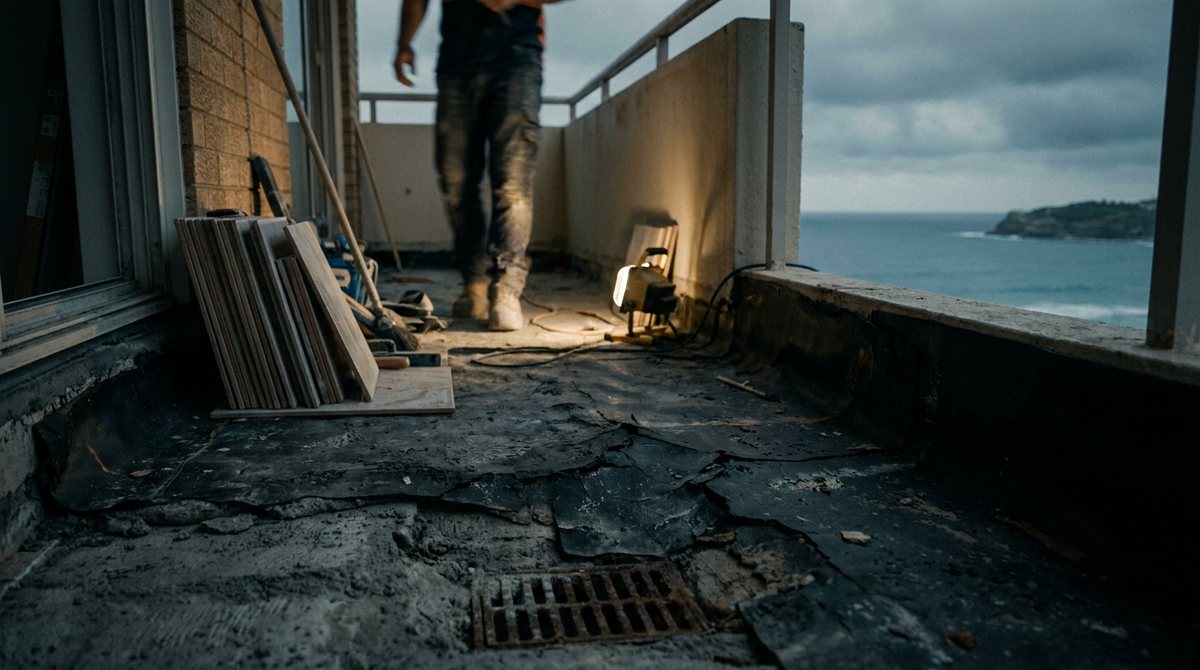
A recoat on a Coogee balcony in 2024 reads as a clean win on the committee's record. Sixteen months on, the same leak is back in the apartment below, the membrane is still failed underneath the new coating, and the building consultant is writing up a full rectification scope. The recoat did nothing structural. The building bought a sixteen-month delay and let the damage keep running.
This is the cosmetic-only trap. Easy to fall into. Slow and structural to climb out of.
What cosmetic-only balcony work actually covers
Cosmetic balcony work means anything done above the tile bed. Retiling. Regrouting. Resealing perimeter joints with new silicone. Applying a topical coating over the existing tiled surface. Painting the balustrade. Replacing a cracked tile. Resetting a wobbly balustrade post in fresh grout.
None of those touch the membrane. None touch the screed underneath. None correct the falls. None address the hob upstand where most balcony leaks actually start. The work can be done in two to three days and looks excellent on handover. The committee sees a fresh balcony. The owner sees their tiles regrouted. Six to twelve months later, water reappears in the apartment below, because the membrane was the actual failure point and the membrane was never in scope.
The Bondi 2007 balcony pattern (anonymised, common)
Eastern suburbs mid-rise, 2007 build, ten balconies on the south facade. Salt-air exposure heavy. Original membrane was a value-engineered sheet system to the 2003 version of AS 4654.
Year one of the cycle, first leak surfaces below balcony six. A contractor regrouts the tiles and recaulks the perimeter. Year two, the leak returns, and a different contractor recommends a topical sealer coat over the tiled surface. The sealer fails within nine months because it cannot bond to a tiled surface with a failed membrane underneath. Year four, a third contractor lifts a few tiles, confirms membrane failure, patches the visible exposed section, and retiles. The membrane is still failed across the rest of the balcony.
Year six, the leak returns again, this time with an insurance claim from the owner below. A building consultant is engaged. The report names membrane failure across all ten balconies and recommends a building-wide rectification. The surface repairs across those six years gave the building zero structural progress. The damage in the apartment below compounded the entire time, and the slab edge began to spall while everyone was looking at the tiles.
Why the surface repair looks good in the moment
Three reasons, and all three evaporate when the leak returns.
The work is faster. Two days on site, one short resident disruption window, finished by Friday. A full rectification needs two to four weeks per balcony, scaffold or swing-stage, residents off the balcony for the duration.
The visible result is satisfying. A regrouted, recoated balcony looks new. The owner above sees the work. The owner below sees nothing change, but the surface up top is bright. And the scope is smaller, so it passes through the committee with less discussion than a full rectification triggers. None of that changes what the membrane is doing fifteen millimetres down.
What to do next
- Refuse cosmetic-only work on balconies where water has surfaced in the apartment below. Surface work does not fix membrane failures.
- Get a tile-lift inspection at the suspected failure point before approving anything. If the membrane underneath is failed, the scope has to include membrane replacement, not just surface work.
- Ask the contractor to write out what is in scope and what is explicitly excluded. A scope that excludes membrane replacement and only covers tile and grout is not a rectification.
- Read the decision as a structural progression. A failed membrane that waits does not hold steady, it reaches the slab.
How Supcon handles this
Supcon does not scope cosmetic-only balcony work over a failed membrane. If the membrane is failed, the scope covers the membrane. If the membrane is sound and the failure is genuinely cosmetic (tile crack from impact, grout discolouration, balustrade fixing rust), the diagnostic confirms that and the work runs as cosmetic with the membrane explicitly noted as inspected and intact.
The scope names the actual cause and addresses the actual cause. There is no shift from cosmetic to structural mid-project, because the diagnostic happens before the scope, not after a deposit. See why the source-fix outlasts the patch for the progression, and the balcony rectification service page for the technical detail.
Get a remedial scope. Send through the issue.