Basement and lift-pit water ingress in Sydney apartments
Water in a Sydney apartment basement or lift pit is a hydrostatic problem, not a surface one. Here's why below-ground water enters, and how crack injection and tanking address it.
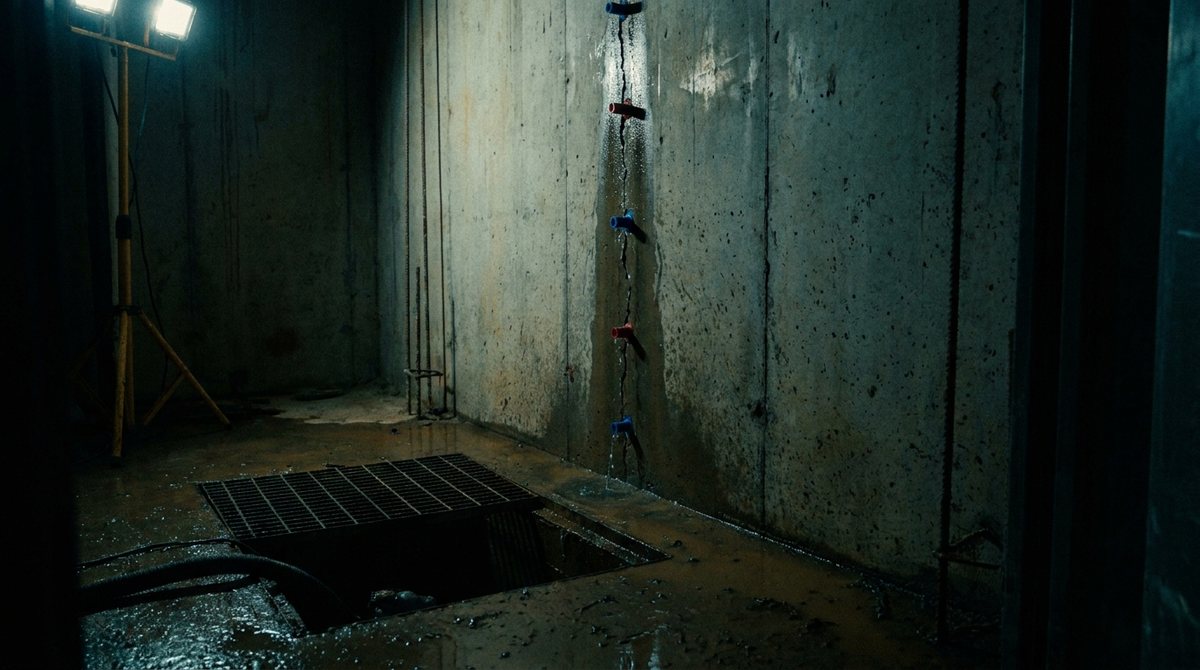
Water is pooling in the lift pit of a Pyrmont apartment building, and seeping through a basement wall a few metres away. This is not rain getting in from above. It is groundwater pushing in from below and around, under hydrostatic pressure, through every crack and joint in the below-ground structure. Basement and lift-pit ingress behaves differently from any leak above ground, and the fix has to deal with water that is actively being pushed at the structure rather than just running down it.
Below ground, the water has pressure behind it. That changes everything about how it gets in and how you stop it.
Why below-ground water is different
A basement or a lift pit sits below the water table, or below the level groundwater reaches after rain. The surrounding ground holds water, and that water exerts hydrostatic pressure against the structure, pressure that increases with depth. Unlike a balcony, where water sits on top and needs only gravity to be a problem, basement water is being actively pushed through any available path.
That means the water finds and exploits every crack, every construction joint, every penetration in the below-ground walls and slab. A hairline crack that would be harmless above ground becomes a weep point below it, because the pressure drives water through. Lift pits are the lowest point in the building and collect whatever gets in, which is why they are so often the first place the problem shows.
Where the water gets in
Cracks in the basement walls and slab are the most common path. Shrinkage cracks, settlement cracks, and cracks at construction joints all become weep points under hydrostatic pressure. Construction joints, the cold joints between separate concrete pours, are a frequent culprit because they are a designed discontinuity in the structure that has to be waterstopped, and where the waterstop failed or was never adequate, the joint leaks.
Penetrations, pipes, conduits, and services passing through the below-ground structure, are another path, each one a hole in the envelope that has to be sealed. And where the original below-ground waterproofing, the tanking applied to the outside of the structure at construction, has failed or was inadequate, water reaches the concrete across whole areas rather than at discrete points.
How crack injection addresses it
For discrete cracks and joints weeping water, polyurethane crack injection is the standard approach. As covered in the injection chemistry, polyurethane reacts with the water present in the crack and cures into a flexible seal that stops the water and accommodates ongoing movement. It works in the wet, which is exactly the condition a basement crack presents, and it can hold back water under pressure when injected properly to the full depth of the crack.
The ports are set along the crack, and the resin is injected to refusal so it reaches right through the wall thickness and seals the crack from the water side as well as the dry side. For construction joints and penetrations, the same logic applies, inject or seal the discontinuity so the pressure-driven water has no path through it.
When tanking or negative-side systems are needed
Where the ingress is not from discrete cracks but from broad areas, the original external tanking has failed, the fix is a waterproofing system rather than point injection. The ideal is to re-establish the tanking on the outside, the positive side, but on an existing buried basement that is usually inaccessible. That is where negative-side waterproofing, a crystalline cementitious system applied from inside, becomes the practical answer, paired with crack injection for the discrete leaks. The combination, inject the cracks and joints, treat the areas with a negative-side system, is the standard approach to a basement that leaks across the board.
What to do next
- Treat basement and lift-pit water as a hydrostatic problem. The water has pressure behind it, so surface coatings alone will not hold.
- On discrete weeping cracks and joints, expect polyurethane injection, which works in the wet and holds under pressure.
- On broad-area ingress from failed tanking, expect a negative-side system paired with crack injection, since the external positive side is usually inaccessible.
- Prioritise the lift pit. It is the lowest point and a flooded pit is a plant and safety issue.
How Supcon handles this
Thomas diagnoses below-ground ingress as the hydrostatic problem it is. Discrete cracks and joints get polyurethane injection to the full wall depth, sealing the water side as well as the dry side. Broad-area ingress from failed tanking gets a crystalline negative-side system paired with the crack injection. The lift pit, as the lowest collection point, is prioritised.
Below ground, you fix the path the pressure is using. See epoxy versus polyurethane crack injection for why polyurethane suits the wet crack, and negative-side waterproofing for the broad-area case. The crack injection service page has the technical detail.
Get a remedial scope. Send through the issue.