Heritage-overlay render repair on period Sydney facades
A heritage-listed Paddington facade cannot take a modern render. Here is how render repair works under a heritage overlay and why the substrate sets the rules.
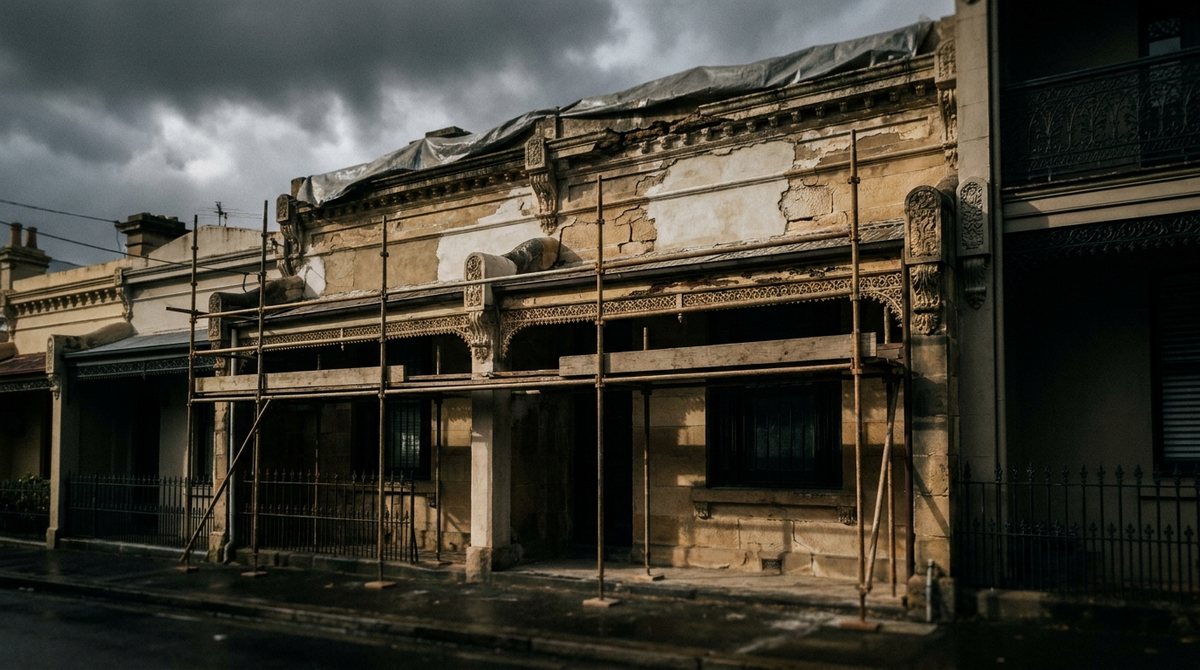
A Paddington terrace under a heritage overlay has render lifting off the parapet and blowing in sheets above the first-floor windows. The owner wants it fixed and matched. The complication is that the facade is protected, the substrate is soft Victorian brick laid in lime mortar, and the modern acrylic render that a standard repair would reach for is exactly the wrong material. Heritage render repair is a different discipline, and the substrate, not the spec sheet, sets the rules.
On a period facade the material has to match the century, the substrate, and the overlay all at once.
Why the modern render delaminates off old brick
Render-substrate compatibility is the whole game on an old facade. A soft, porous Victorian brick laid in lime mortar moves and breathes. A hard, rigid, impervious modern render laid over it cannot move with the wall and cannot let it breathe. So the bond fails. The render debonds in sheets, traps moisture behind it, and that moisture drives the next failure as it freezes, salts, and pushes the render off.
The original render on these facades was a lime-based or soft cement system, chosen, knowingly or not, to be softer than the brick behind it. That is the rule on heritage masonry, and it is why modern masonry practice under AS 3700 cannot simply be transplanted onto a Victorian wall. The render should be weaker than the substrate, so the render sacrifices first and the historic brick is protected. A hard modern render reverses that. The brick spalls before the render does, and now the protected fabric is the thing being damaged. On a heritage-listed wall, that is the outcome the overlay exists to prevent.
What the heritage overlay requires
A heritage overlay or listing means the facade cannot simply be repaired to whatever is convenient. The work usually needs to match the original in material, finish, and profile, and on a listed property it may require approval before it proceeds. The render system has to be sympathetic to the original, the profiles and mouldings reinstated to match, and the finish consistent with the period.
This is where a remedial scope on a heritage facade has to do more than name a product. It has to confirm what the original render was, specify a compatible system that satisfies the overlay, account for matching the existing profiles, and sequence the approval where one is needed. A scope that skips this lands the owner with a council problem on top of a building one.
How the render gets matched
Matching a heritage render is a craft call. The existing render gets assessed for its composition and finish. A compatible lime-rich or soft system is specified to sit weaker than the brick. The mouldings, cornices, and parapet profiles that define a Victorian or Federation facade get reinstated to match the surviving original, not approximated. The finish texture and the final colour are matched to the period and the streetscape.
This is finishes work at the demanding end, and it draws directly on a dedicated render specialism. A facade that reads as a faithful repair holds the heritage value. A facade patched in mismatched modern render reads as damage, and on a listed property it is a compliance issue as much as a visual one.
What to do next
- On a heritage-overlay facade, confirm what the original render was before any repair is specified. The substrate and the original system set the rules.
- Refuse a hard modern acrylic or cement render on soft Victorian brick. It debonds and it spalls the protected fabric.
- Check whether the overlay requires council approval before work proceeds, and have the scope sequence it.
- Insist that profiles, mouldings, and finish are matched to the original, not approximated. On a listed facade the match is the point.
How Supcon handles this
Thomas Pencarinha assesses the original render and the brick substrate before a system is specified, and chooses a render that sits weaker than the brick so the historic fabric is protected. The profiles and mouldings are reinstated to match. Where the overlay requires approval, the scope accounts for it. The finish is held to the standard set on demanding render and microcement work.
A period facade rewards a render matched to its century and its substrate, not a modern default. See render systems and substrate compatibility on old brick for the compatibility detail, and managing heritage-overlay remedial work for the approval side. The facade repair service page carries the technical detail.
Get a remedial scope. Send through the issue.